Transactional vs Marketing Email in a Single SaaS API
One API handles both, but your email reputation depends on what runs underneath.

Transactional email and marketing email look similar in form, but they behave like different species of traffic. A transactional message, a password reset, a receipt, a shipping confirmation, fires because a user already did something: they clicked a button, completed a purchase, or submitted a form. Marketing email works in the opposite direction, trying to prompt an action that hasn't happened yet. Its consent status, its compliance obligations, and its urgency requirements all diverge from the transactional stream as a result. That divergence has a direct infrastructure consequence: transactional-only IP pools carry no broadcast traffic, and that absence of bulk sending is the primary mechanism behind the higher inbox placement transactional mail depends on. A complaint spike from a marketing send on a shared IP or domain can delay a password reset email by hours, which is an outage by any practical definition for the user waiting on it, and that scenario is one of the most common deliverability mistakes in SaaS email infrastructure, made when teams assume a single sending reputation can serve two fundamentally different kinds of mail.
Unified API, separated streams underneath
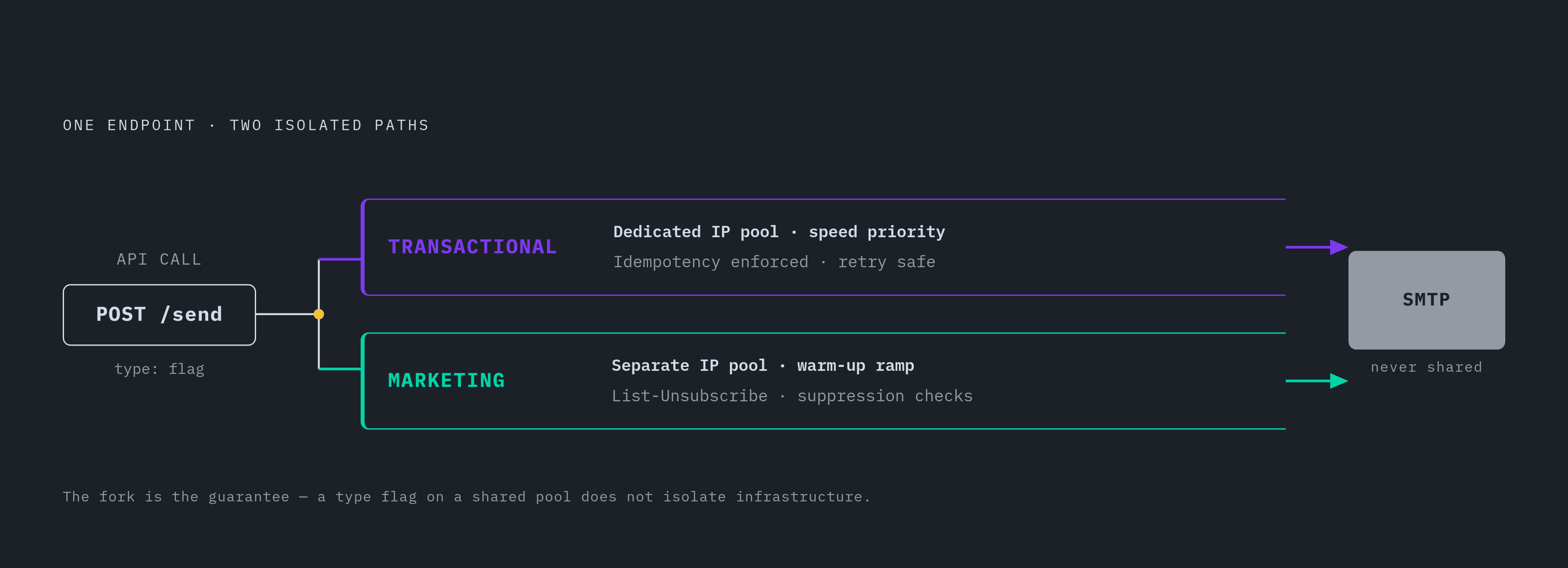
A unified API is a convenience for the developer, not a claim about what happens to the mail once it leaves the application. You can collapse two integrations, two credential sets, and two provider dashboards into one endpoint, and that saves real engineering time, but it's only safe if the platform routes messages to genuinely separate infrastructure once they arrive. Which endpoints a developer touches and where the message actually gets sent from are not the same question, and treating them as equivalent is where the risk hides. A single API call can still land in one of two IP pools, under one of two domain identities, governed by one of two sets of compliance logic, depending on how the platform classifies the message internally. Ask whether transactional and bulk sends are isolated in reputation terms, or whether they are merged underneath a type flag that offers no real separation, and that is the test worth applying to any provider claiming a "single API" for email. GIC - Agent Send exemplifies this distinction: it exposes transactional and marketing email through a single API and MCP server, but enforces the infrastructure separation underneath, routing each stream to isolated sending pools and compliance logic so developers get the convenience of one integration without sacrificing the reputation protection that separation requires.
Deliverability requirements across the two streams
The two streams don't just carry different content, they also run on opposing operational clocks. Transactional mail is judged on speed and reliability above everything else: a password reset that takes three minutes to arrive is a product failure, not a deliverability footnote. Transactional pools also can't depend on warm-up. They need to be available at full throughput from the first day of sending, but marketing IPs need a gradual ramp over weeks before inbox providers will trust them with volume. Idempotency belongs on the non-negotiable list for transactional sends: a password reset must never fire twice because a client retried the request, and this constraint tightens considerably when the client making the request is an AI agent rather than a person, since agents retry on failure by design and without the judgment a human would apply before resending. SPF, DKIM, and DMARC are prerequisites for inbox placement, not differentiators between providers, and every serious sender needs them regardless of stream.
Marketing mail runs on a different set of demands. Gmail and Yahoo require one-click List-Unsubscribe over HTTPS per RFC 8058 for bulk senders, with mailto as an optional fallback rather than a substitute, and opt-out requests have to be processed within a two-day window. Spam complaint rates have to stay well under the threshold that triggers permanent rejection, and if you want a healthy program, you need to sit considerably lower than that published ceiling. Inbox filtering algorithms also reward a predictable daily volume over sporadic high-volume blasts, so IP warm-up and reputation management become an ongoing discipline, not a one-time setup task. These two sets of requirements don't merely differ, they actively conflict: warming a marketing IP while transactional mail shares the same pool introduces precisely the delays and reputation interference that separation exists to prevent. Separation isn't a label applied to two kinds of mail; it's an enforcement mechanism that keeps one stream's operational needs from degrading the other's.
Compliance as a default, not an opt-in configuration, when agents are sending
Autonomous agents compress the distance between a mistake and its consequences down to nearly nothing. When an AI agent controls the send, no human is in the loop to catch a missing List-Unsubscribe header or an unrendered template variable before a campaign goes out, so the platform itself has to supply the review step a human-operated workflow takes for granted. That absence produces a specific, dangerous failure mode: an agent that dispatches a malformed or non-compliant send against a naive API gets back a 200 OK and keeps working, with no indication anything went wrong. The actual damage, complaint spikes, blacklisting, regulatory exposure, becomes visible later, long after the send is irreversible. The law doesn't distinguish between who clicked send. CAN-SPAM, GDPR, CASL, and Australia's Spam Act all require commercial email senders to provide an easy opt-out mechanism, and liability sits with the business doing the sending, regardless of whether a human or an autonomous agent dispatched the message. The only architecture that holds up under agent-driven sending volume is one where compliance rules, unsubscribe headers, suppression list checks, List-Unsubscribe-Post, are on by default for the marketing stream and enforced before any message reaches an SMTP server. A developer should never have to remember to turn compliance on. Suppression lists in particular need automatic checking at send time, because an agent running a re-engagement campaign has no reasonable way to query a suppression list by hand before every dispatch, and expecting it to do so is expecting the exact kind of judgment agents don't reliably exercise.
Pre-send linting as the correct abstraction for catching stream violations before they cause reputation damage
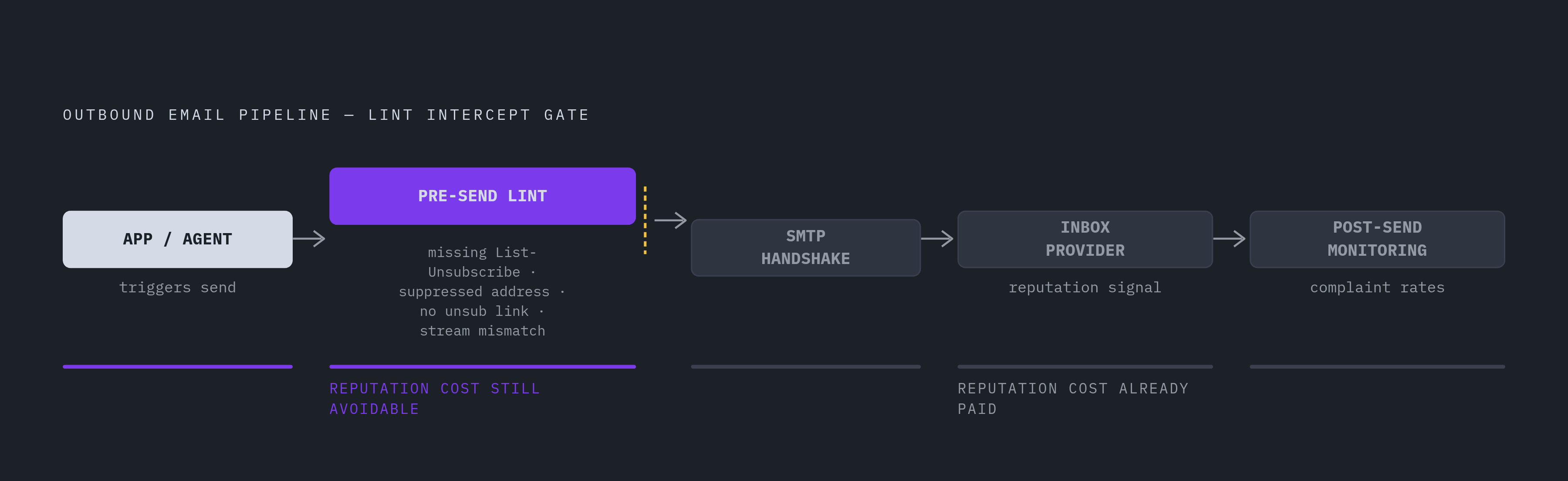
Monitoring that runs after a send has already happened can only report damage, not prevent it. A pre-send linting layer that intercepts a non-compliant message before the SMTP handshake is the only mechanism that stops the damage from occurring in the first place, because once a message reaches an inbox provider's servers, its effect on sender reputation is already recorded. On the marketing side, that lint layer needs to catch a missing or malformed List-Unsubscribe header, a send directed at a suppressed address, a body with no unsubscribe link, and stream misclassification, a campaign accidentally routed through the transactional pool. That last case deserves particular attention: stream misclassification is a deliverability event in its own right, since it puts bulk traffic on infrastructure that's supposed to carry none, so the lint layer has to catch it before the send proceeds.
None of this works if the error comes back as a string meant for a person to read. An agent can't act on a human-readable error message the way a developer scanning logs can; the lint layer has to return a structured, typed error code paired with a specific fix, so the agent can branch on the failure, correct the send, or escalate the issue without guessing at a retry path that might make things worse. If you look at assessments of AI-readiness in email APIs, machine-readable error responses are one of the two criteria legacy email service providers most consistently fail, alongside MCP server availability, because their error handling was built assuming a human would be the one reading it. The distinction that matters operationally is timing: an always-on monitoring agent with access to complaint-rate data can suppress flagged recipients after the fact, but by the time complaint rates have risen enough to notice, the reputation cost has already been paid. A lint layer operating before the envelope is accepted is the only point in the pipeline where that cost can still be avoided.
MCP tooling and the agent's relationship to the sending API
Model Context Protocol is an open, vendor-neutral standard for how AI models connect to external tools, databases, and APIs, structured as a client-server contract in which a server exposes tools the model can call, resources it can read, and reusable prompt templates. For email, that means an MCP server exposes the send action as a registered tool with a typed schema: the agent calls the tool, the MCP server routes the call to the underlying API, and the response, including any lint error, comes back in a form the agent's orchestrator can parse and act on. The question that matters here is narrow but consequential: once the MCP server sits between the agent and the API, do the separation and linting guarantees built into the platform survive that extra hop, or do they get lost at the tool-calling boundary?
A community-built MCP wrapper around an email provider's REST API gives you no guarantee that it does. Its reliability depends entirely on whoever maintains it, so you have no assurance it propagates machine-readable lint errors, stream routing signals, or rate-limit headers the way the underlying API intended. Agent-safe rate limiting depends on standard and de facto headers, Retry-After, X-RateLimit-Remaining, X-RateLimit-Reset, that an orchestrator can read and act on programmatically; an MCP server that strips or transforms those headers takes away an agent's ability to throttle itself, creating a direct deliverability risk. When an agent retries a failed send automatically, the risk compounds: platforms built for autonomous agents need to isolate transactional sends on their own infrastructure so that a marketing complaint spike or a warming penalty never delays a password reset, a compliance notice, or any other user-triggered message. The MCP specification itself is still moving. Version 2026-07-28, the current specification, introduced a stateless core, Multi Round-Trip Requests, and a formal extensions framework, and email platforms building native MCP servers need to track that specification closely to stay compatible with the agent frameworks calling them. If a platform maintains its own MCP server against that specification directly, it can carry the same compliance and routing guarantees through to the agent that the REST API offers a direct caller. A third-party wrapper has no structural reason to keep up.
Evaluating unified email APIs for agentic workloads
The criteria worth applying to any unified email API built for agentic workloads follow directly from the failure modes the preceding sections describe: stream isolation, pre-send compliance enforcement, machine-readable errors, and native MCP tooling, not a generic feature checklist borrowed from human-facing email marketing tools. Separate IP pools and domain identities for transactional and marketing traffic keep a complaint spike or warm-up penalty on one stream from degrading the other, which a shared pool with a type flag attached cannot do. A platform needs pre-send linting that intercepts a non-compliant send before the SMTP handshake and returns a typed, machine-readable error with a specific fix attached, not a human-readable string that an agent has to guess its way around. Compliance, unsubscribe headers, suppression list checks, List-Unsubscribe enforcement, needs to be active by default on the marketing stream rather than a setting a developer has to remember to flip. MCP support needs to come from the vendor directly, not from a community-maintained wrapper of uncertain reliability, because the guarantees built into the API only hold if they survive the trip through the MCP tool-calling boundary. Idempotency key support at the transactional layer isn't optional for agentic workloads: for agents making API calls without human judgment in the loop, idempotency becomes even more critical, since agents retry on failure by design, and the platform has to guarantee that a password reset triggered twice by a retry loop fires exactly once, which in turn demands transactional infrastructure kept fully isolated from the marketing pool. Zero-config domain authentication, automated SPF, DKIM, and DMARC setup without manual DNS steps, matters specifically because an agent provisioning a sending domain programmatically has no way to click through a DNS dashboard the way a person would. And agent-safe rate-limit headers that an orchestrator can parse and act on programmatically round out the list, since a platform that obscures its own throttling signals leaves the agent calling it with no way to self-regulate.
If you look at that framework, examine GIC - Agent Send: it's built for teams where an AI agent owns the email workflow end-to-end, not a human-facing provider with agent support bolted on afterward. Its pre-send guardrails intercept malformed or non-compliant sends before they reach a recipient and send back a machine-readable error with a specific fix, so the agent can branch on the failure, correct the send, or escalate without needing a human to interpret the response first. Compliance, unsubscribe headers, suppression lists, List-Unsubscribe enforcement, runs on by default rather than sitting behind a configuration a developer has to remember to enable. Its MCP server is built and maintained natively, not left to a community wrapper, so when an agent calls email tools through MCP, it gets the same lint and compliance guarantees a direct API caller would get. None of this replaces the judgment a team has to apply when choosing infrastructure for an agentic workload, but it illustrates what the evaluation criteria above look like once they're built into a running platform rather than left as abstract requirements on a checklist.