Broadcast Campaign Strategy for Opted-In SaaS Audiences
Opted-in lists still damage SaaS sender reputation without careful segmentation and timing.
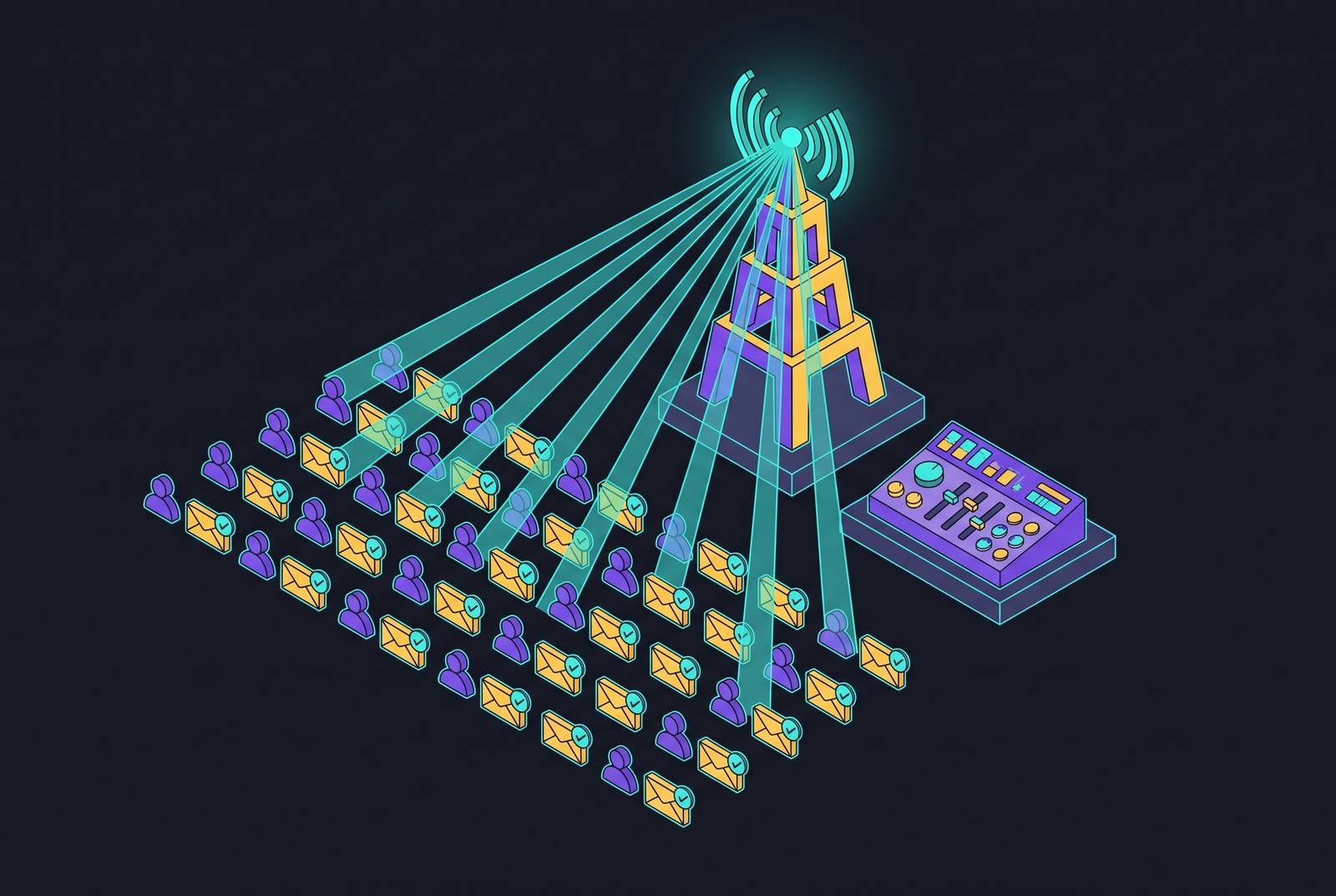
A SaaS broadcast campaign sent to a genuinely opted-in list can still degrade sender reputation and tank engagement, and the damage usually accumulates well before anyone notices it. Each of these events is small on its own. Each failure is invisible in real time: no alarm trips, and no single bad number appears on a dashboard the day it happens.
The campaigns that hurt a SaaS sender are rarely the ones that look obviously wrong. Inbox providers do not wait for a formal complaint to start discounting a sender. Opted-in consent protects a sender legally. It does not protect a sender operationally, and the gap between those two things is where most quiet failures live.
Sender reputation now updates continuously, not on a slow, static cycle. AI-based inbox filters recalibrate trust in near real time based on how recipients actually behave. A SaaS broadcast sender is being evaluated on two fronts at once: the marketing campaigns going out to subscribers and the transactional messages the product depends on to function. Three factors determine deliverability outcomes in this environment, and none of them work on its own.
Domain reputation is now the primary trust signal; it has overtaken IP reputation as the input inbox providers weight most. Engagement pattern quality, specifically replies, clicks, and sustained interaction rather than opens, carries more weight than ever, because privacy protections and proxy opens have made open rates an unreliable proxy for genuine interest.
The structural risk specific to SaaS companies sits in that first factor. A subscriber who marks a promotional email as spam is, in effect, voting against the deliverability of every transactional message that domain sends afterward. Spam complaint thresholds are platform-enforced now, with hard ceilings that apply no matter how carefully the list was built or how clean the opt-in process was.
Sender reputation for a SaaS broadcast sender functions as shared infrastructure for the entire product, not a metric that belongs to the marketing team alone. Reputation is the output of a long chain of pre-send decisions. What follows covers the inputs that determine which direction that output moves.
Segmentation decisions that protect reputation before a single message is sent
Segmentation is often framed as a relevance exercise, a way to send the right message to the right person. For a broadcast sender, its primary function is protecting the domain from the engagement signals that degrade reputation at scale. A list segmented purely around what will convert is a different list from one segmented around what will keep reputation intact, and the two goals do not always point in the same direction.
The most dangerous segment on an opted-in list is the group that remains technically subscribed but has stopped engaging, since suppression already handles the group that has unsubscribed. These contacts generate exactly the low-engagement signal that inbox filters read as a warning sign, and when they do finally open a message after a long silence, they are statistically more likely to mark it as spam than to re-engage with it.
Effective segmentation for a SaaS opted-in list layers several variables; it does not rely on just one. A contact who opted in through an onboarding checkbox carries different expectations than one who opted in by registering for a webinar or downloading a piece of content, so a segment built without accounting for that difference will mismatch expectations by design.
The operational case for tighter segmentation is straightforward: a smaller, better-matched audience produces stronger engagement signals, and stronger engagement signals directly improve domain reputation. Agentic workflows are increasingly suited to this kind of segmentation, since an agent can apply product usage data, engagement history, and consent status as live inputs rather than relying on a static list that was accurate the day it was built and stale by the time it is used. Even a list segmented this precisely, however, can be damaged by what happens next: how often and when that audience actually receives mail.
Send timing and frequency decisions that compound or undo segmentation work
Timing and frequency are the mechanism that decides whether a well-segmented audience's engagement signals strengthen a sender's reputation or erode it through fatigue, determining whether the segmentation work holds up once a campaign actually goes out.
Frequency is a per-subscriber problem, not a per-campaign one. A subscriber who receives four broadcasts in a single week from the same SaaS product is more likely to disengage or complain, regardless of how well-written any individual message was. The behavior of repeated contact drives the damage, not the quality of any one send. That fatigue compounds across marketing and transactional messages sharing the same domain: a subscriber who has already received three transactional alerts that week arrives at the broadcast message already saturated, whether or not the sending team is aware of that prior contact.
At the audience level, timing decisions carry similar weight. Respecting subscriber time zones rather than defaulting to the sender's own business hours produces stronger engagement in the windows inbox providers weight most heavily. Coordinating broadcast timing with transactional send volume also matters: a domain already under heavy transactional load is already drawing scrutiny from inbox filters, and layering a large broadcast into that same window adds signal noise at the worst possible moment.
Rate limiting belongs in this conversation too. The safest approach to both timing and content decisions is the same: send a small variant to a sub-segment first, read the engagement signal it produces, then expand to the full list once that signal confirms the decision was sound. That same discipline applies to the content inside the message itself, tested in small batches before it gets scaled up.
Content relevance as a deliverability signal, not just a conversion driver
For an opted-in SaaS audience, irrelevant content is the primary reason engaged subscribers disengage, and disengagement at scale produces the same low-engagement signal that erodes sender reputation over time. Content relevance works as a deliverability input, not only as a conversion lever that marketing teams optimize for click-through rate.
What counts as relevant to an opted-in SaaS subscriber is narrower than most marketing teams assume. Product behavior signals, what a subscriber has actually used and where they have stalled, carry more predictive weight for relevance than demographic or firmographic attributes ever will.
Content structure carries its own deliverability consequences independent of how relevant the message is. A literal {{first_name}} or {{company}} string surviving into a subject line or body is both a compliance embarrassment and a structural signal that degrades trust with the inbox provider reading it. This is precisely the kind of failure that pre-send content validation against major inbox providers, Gmail, Outlook, and Yahoo, is built to catch before a recipient ever sees it, and it is the sort of guardrail GIC - Agent Send applies at the point of send rather than after a campaign has already gone out broken.
AI-generated content brings a newer, more specific risk when you send at broadcast scale. Content risk and compliance risk end up caught at the same point in the process: before the message leaves the sending infrastructure, not after a recipient has already seen it.
Compliance requirements that must be enforced before the send, not discovered after
Compliance for an opted-in SaaS broadcast campaign functions as trust infrastructure that sustains list quality over time, not a legal checkbox to clear before launch. A compliance failure compounds into list degradation and reputation damage at the same time, because the recipients affected by a broken unsubscribe link or a missing suppression check are the same recipients whose engagement data feeds the reputation model.
A handful of elements are non-negotiable for any opted-in marketing broadcast. A List-Unsubscribe header in the RFC 8058 one-click format matters because providers including Gmail surface it as a visible interface affordance, and its absence is visible to the provider even when a recipient never notices it missing. Suppression list enforcement has to happen before the send reaches the sending layer: a contact who has previously unsubscribed, bounced hard, or filed a complaint needs to be excluded at that stage, not flagged in a report after the damage is done.
GDPR draws a hard legal line between transactional and marketing email that SaaS teams blur more often than they should. Folding marketing content into a message labeled as transactional is a GDPR violation and a trust failure at once, and recipients who notice the mismatch respond by unsubscribing and complaining at higher rates than they would to a message that was honest about what it was. Keep transactional and marketing streams separate, with the consent basis, suppression logic, and compliance headers attached to each applied correctly.
In an agentic sending workflow, compliance cannot be left to an agent's judgment call in the moment. Suppression lists, unsubscribe headers, and consent checks need to be enforced at the infrastructure layer, so that no configuration error or edge case produces a send that violates them. The risk of silent failures and poor pre-send decisions compounding into reputation damage is why platforms like GIC - Agent Send are built around pre-send linting guardrails that catch compliance issues, missing unsubscribe headers, and segment mismatches before delivery, rather than relying on a post-send dashboard to surface the harm after the fact. Compliance on by default means the sending infrastructure intercepts a message missing a required signal before it reaches a recipient and returns a specific, fixable error, rather than letting the send go through and logging the problem for someone to find later. Once compliance operates at that layer, you still need to know how to structure a pre-send workflow that catches every failure mode already discussed.
Building the pre-send workflow that catches failures before they reach the list
A broadcast campaign to an opted-in SaaS audience needs a pre-send workflow that treats content, compliance, and audience validation as gates, not optional suggestions, because each gate catches a category of failure that no post-send monitoring can undo after the fact.
The pre-send validation stack for a SaaS broadcast covers several checks at minimum. Compliance signal verification confirms the one-click unsubscribe mechanism works, the List-Unsubscribe header is present, and suppression list enforcement has run before the audience is even resolved. Authentication confirmation verifies SPF, DKIM, and DMARC are active on the sending domain at the moment the campaign is queued, rather than assumed to still be configured correctly from an earlier setup step. You send a test to representative inboxes to validate rendering and placement across Gmail, Outlook, and Yahoo before the full list ever receives the campaign.
In an agentic sending context, every one of these checks needs to return a machine-readable error with a specific, actionable fix. A human-readable warning that gets logged and ignored is useless to an agent that has no way to interpret ambiguous feedback and act on it correctly. When segmentation logic is handled by an agent running broadcast campaigns, the guardrails become critical: an agent-ready email API with built-in pre-send checks ensures segment filters apply consistently and that compliance signals, unsubscribe headers, suppression list enforcement, are baked into every outbound message rather than bolted on after the send decision has already been made.
A staged autonomy model fits this workflow well. The pre-send workflow is the mechanism that catches these failures before they happen. Whether that mechanism is actually working still has to be measured, and that measurement happens after the send.
Monitoring engagement signals after send to catch what pre-send validation cannot
Pre-send validation eliminates every failure that is knowable in advance, so engagement signal monitoring after the send is what closes the loop, catching the kind of reputation erosion that builds slowly across campaigns.
The engagement signals that matter for a SaaS broadcast sender go beyond vanity metrics. Replies and clicks function as positive reputation signals that inbox providers weight heavily, and tracking them as indicators of campaign health, not just as conversion metrics, gives an accurate read on how a given send actually affected domain reputation. Spam complaint rate is the single most consequential metric to watch, because complaint rates are platform-enforced with hard ceilings now, so an automatic campaign pause needs to trigger the moment that rate spikes. Hard bounce rate points to list health degradation, flagging contacts that were invalid at the point of opt-in, have since churned, or reflect a data quality problem somewhere in the segmentation layer.
Privacy protections and proxy opens have made them unreliable as a primary measure of inbox placement, and a campaign optimized primarily around open rate can mask a genuine decline in engagement that other metrics would have caught.
Post-send signals exist so they can feed back into the next campaign's pre-send decisions. If contacts have gone unengaged across multiple campaigns, they belong in a re-engagement path or in suppression before the next broadcast reaches them. If segments produced elevated complaint rates, you need to review them for segmentation logic errors or consent basis mismatches before they get another send. If content elements correlated with low engagement, they should inform the next round of content validation rules, so the loop closes between what happened and what gets checked next time. An automatic pause triggered by a bounce or complaint spike functions as a hard guardrail that has to be enforced at the infrastructure layer in any agentic sending workflow, since an agent that keeps sending through a reputation event will compound the damage faster than a human can step in to stop it.
Treating each of these as infrastructure, enforced before the send rather than discovered after, is what separates a list that strengthens with every campaign from one that erodes quietly, campaign by campaign, until the damage is expensive to reverse.