One Integration Point for Every Lifecycle Stage an AI Agent Touches in SaaS
One email API that covers signup through billing keeps agents from failing between stages.
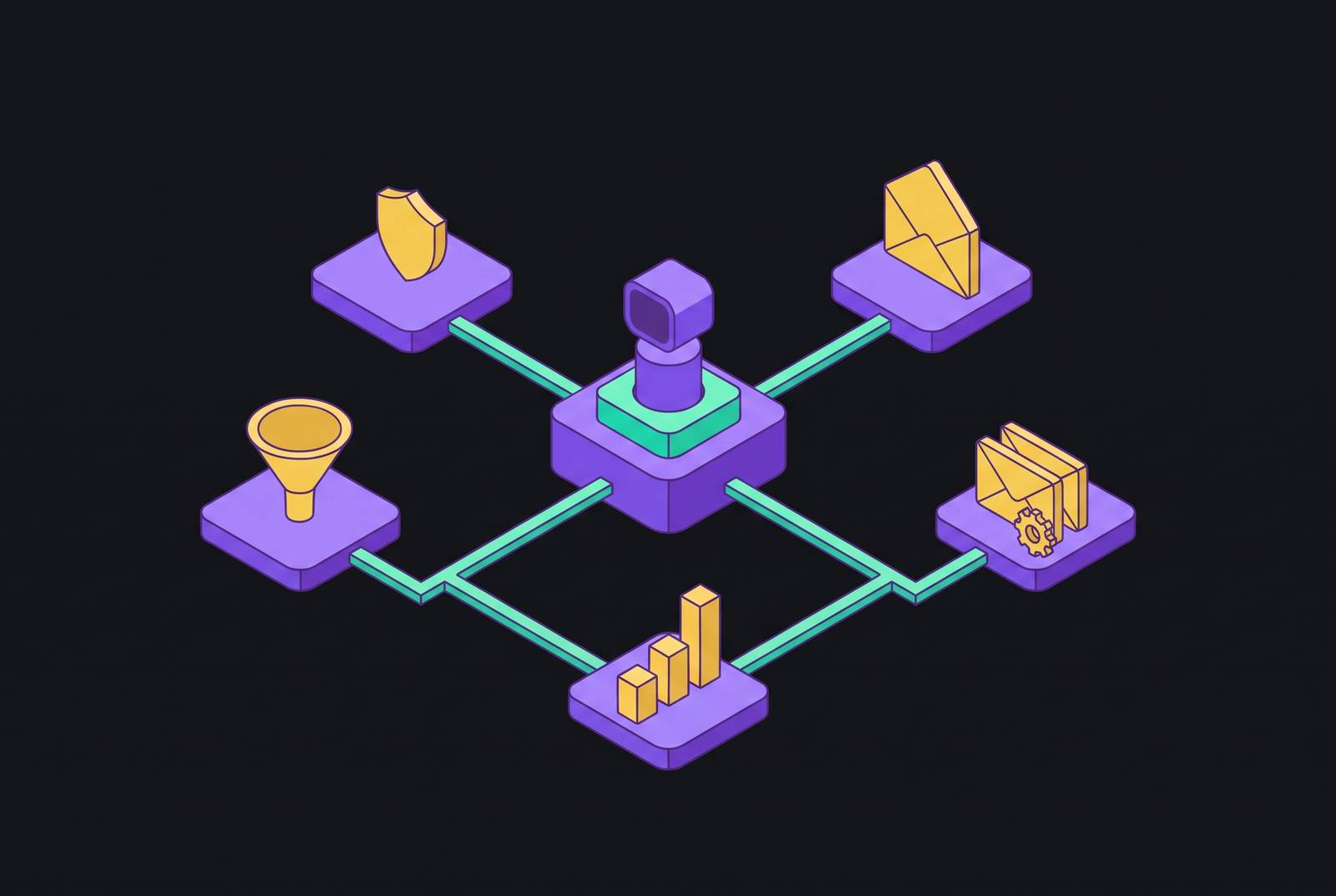
A unified transactional and marketing email API for AI applications must support the whole agent lifecycle, including sending receipts and newsletters from one platform. That means combining inbox provisioning, sequence control, isolated sending streams, safe reply handling, and billing automation through an agent-readable interface. The case for one integration point is that gaps between these capabilities compound into production failures.
Why every lifecycle stage an AI agent touches in SaaS demands a distinct email capability
SaaS agents are becoming autonomous, first-class actors. That changes the assumptions behind email infrastructure. A developer could fill in a form, copy an API key, and click a verification link, but an autonomous agent needs machine-accessible ways to complete those steps. A workflow that stops for human help at each transition is not autonomous from end to end.
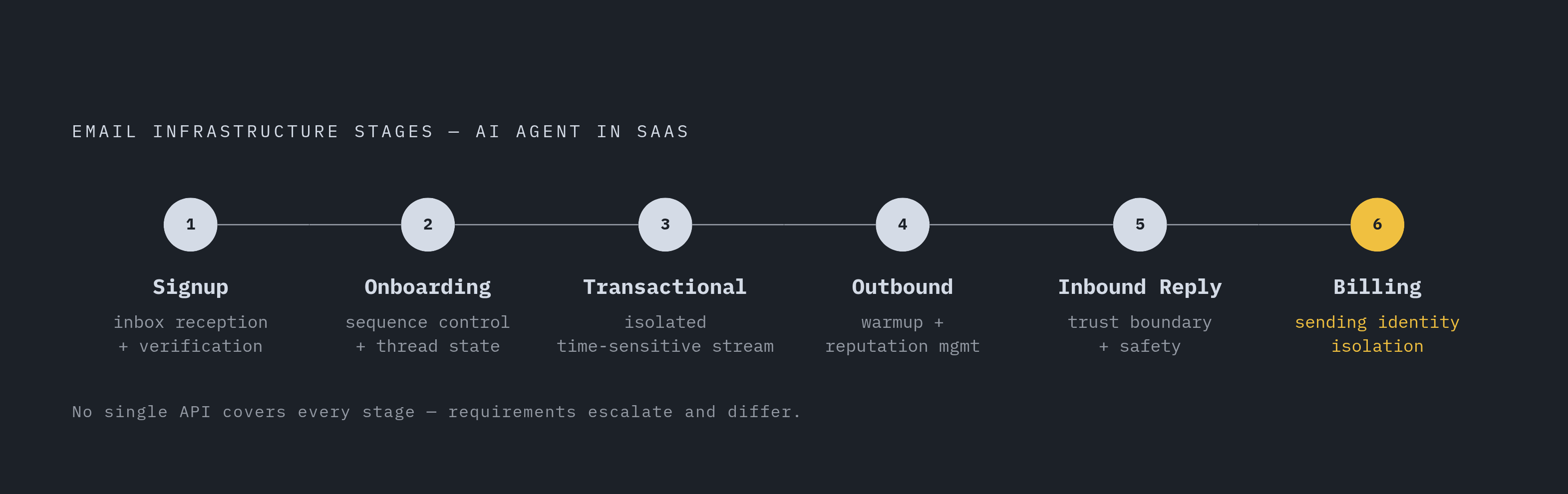
The requirements change across six stages, which are signup, onboarding, transactional alerts, outbound outreach, inbound reply handling, and billing. Signup requires reception, while onboarding adds sequence control and conversation state. Operational alerts must arrive on time, outreach needs reputation management, inbound messages cross a trust boundary, and missed billing messages can cost revenue. A transactional sending API alone does not cover this range.
What agents need from email infrastructure that humans never did
Agents need infrastructure to do work that people handle with an inbox and their own judgment. The baseline includes programmatic inbox creation, structured message parsing, attachment access, real-time events, and thread-aware replies. Durable thread state lets an agent connect a response to the conversation that prompted it. Without that state, receiving a message is not enough.
Identity and permissions form a second requirement. Each agent needs its own address and sending identity, with scoped API keys and boundaries between agents or workflows. An agent sharing a corporate sending domain exposes that domain’s reputation to its behavior. A dedicated inbox also provides a clean, queryable record of what the agent sent and received without mixing that record with human correspondence.
The interface must be usable without a dashboard. MCP tool definitions, cryptographically signed event payloads, per-agent rate limits, and multi-agent isolation provide criteria for evaluating infrastructure across the lifecycle. These controls serve different purposes. Event signatures support authenticated delivery, permissions constrain access, and rate limits govern volume, so none substitutes for the others.
Stage one: signup — the verification-email wall that stops agents before they start
An agent completes a signup form and stops at “we've sent you a verification email.” It has no inbox it can access. A research agent needing a developer account on a data source, a QA agent registering for a SaaS on each test run, and a purchasing agent creating a marketplace buyer profile all encounter the same gate. Every later capability remains unreachable until that email can be received and acted on.
An agent-owned hosted mailbox closes this gap. The agent registers with its own address, receives the verification message through a webhook, and completes the registration without a human copying the link. Programmatic inbox creation and an inbound_message_received webhook subscription express the implementation pattern. Reception is part of the signup interface.
Credentials can block the workflow even earlier. Password-only access, API keys offered only after a sales call, or required SMS verification can stop an agent from registering on its own. Some providers remove the subscription dependency by allowing agents to create inboxes and pay per request over x402.
Stage two: onboarding — drip sequences an agent must both trigger and respond to
After registration, email becomes a two-sided workflow. A SaaS product driven by an agent must send lifecycle sequences and respond when users reply or take action. A visual journey builder assumes a person configures those transitions. An agent instead needs programmatic control to trigger, branch, and exit sequences from runtime events.
Replies make sequence control a state problem. The agent must match an incoming response to its original message through In-Reply-To/Message-ID and continue the conversation in context. Otherwise, the sending system may advance a drip sequence without knowing that the user has already responded. Outbound automation then proceeds on incomplete information.
This is the structural gap between message delivery and lifecycle automation. A support agent that sends onboarding messages but cannot process replies leaves the conversation unfinished. A human must close that loop. The infrastructure needs a send endpoint and durable thread continuity so it can make programmatic sequence decisions.
Stage three: transactional alerts — time-sensitive messages that must arrive in a separate, isolated stream
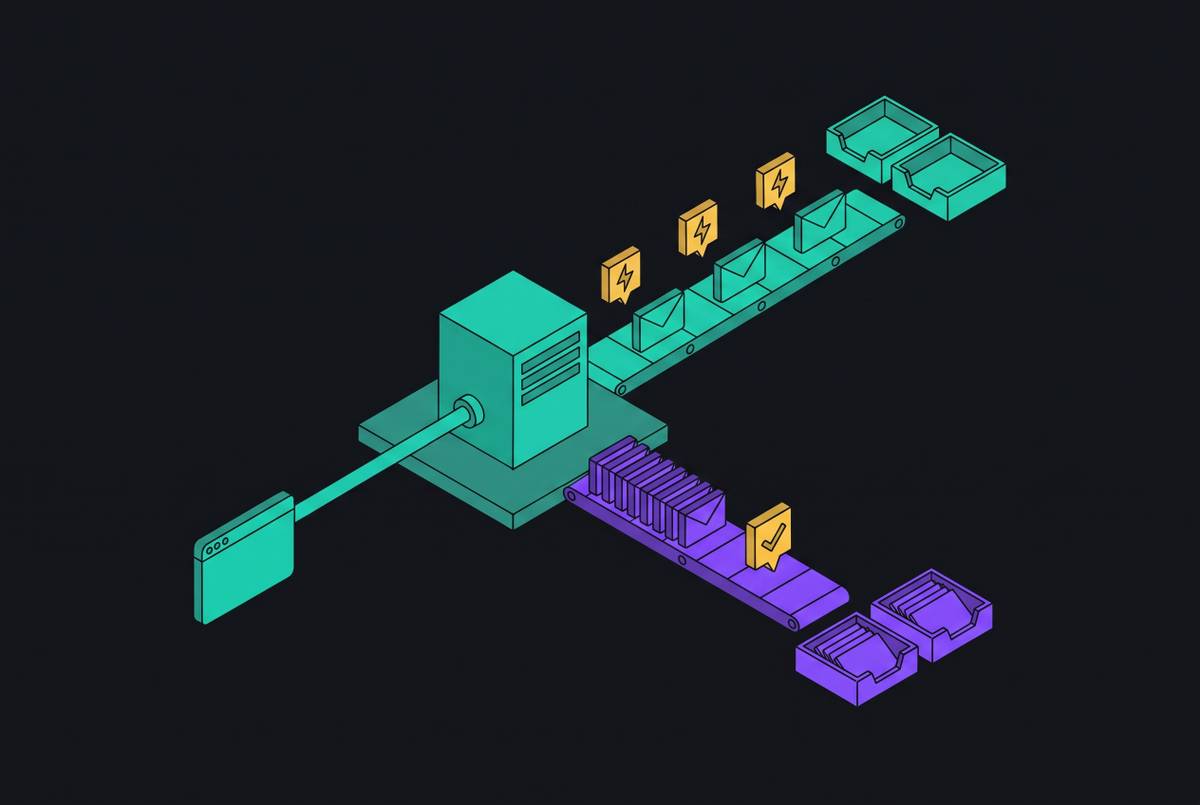
An agent run may need approval before taking an irreversible action, a tool call may fail halfway, or a usage cap may be reached on a Sunday. These are runtime events. Their messages must reach the recipient promptly because the workflow depends on a decision or intervention. Delivery cannot safely inherit the reputation risk of outreach traffic.
Stream isolation is the core requirement here. Postmark’s Message Streams architecture separates transactional, broadcast, and inbound traffic on separate infrastructure. That design provides a concrete distinction between a unified interface and a shared delivery stream. A spike in outreach should not degrade delivery of approval requests or billing notices merely because the application sends both through one integration.
A weekly agent digest must describe work for one customer without exposing another customer’s information, so template logic must be scoped per tenant.
Stage four: outbound outreach — sender reputation and warmup requirements agents skip by default
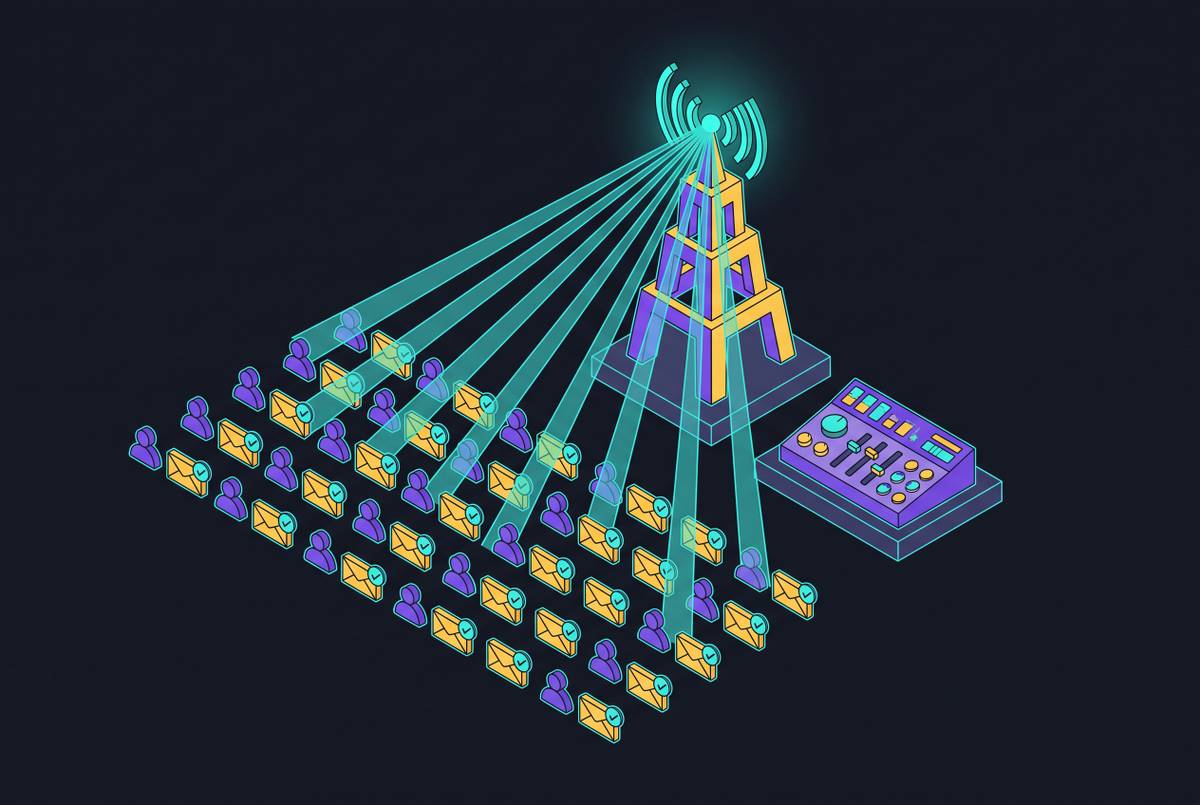
Outbound outreach can fail silently until deliverability collapses. The agent may keep producing messages while its sending reputation deteriorates. Speed, volume, and autonomy make agents useful, but those same qualities can resemble abuse when sending begins abruptly. Humans are slow, so their sending volume grows gradually. Agents need controls to make that happen.
An agent needs warmup before cold outreach and controls on sending after that. A high-volume agent should not send from the primary corporate domain. A dedicated subdomain such as agents.yourcompany.com separates the outreach identity from human correspondence and billing notifications. Because reputation is scored per sending domain and IP, isolation must address the delivery infrastructure as well as the visible address.
Authentication and complaint monitoring complete that boundary. Gmail and Yahoo’s 2024 bulk sender rules include DMARC alignment and one-click List-Unsubscribe under RFC 8058. ARC for forwarders is separate general guidance that applies alongside those bulk-sender requirements. The operational guidance in the notes calls for halting sending before the complaint rate reaches 0.2%, ahead of enforcement. An agent must keep that stop condition even if it can send faster.
Stage five: inbound reply handling — the safety risk that outbound-focused teams consistently underestimate
Inbound email is a trust boundary. An attacker can place instructions in a message body that an agent interprets as commands. That prompt injection can trigger actions the operator never authorized. Outbound failure is principally a deliverability problem. Inbound failure can become an authority problem.
The architectural rule follows from that distinction. Email contents must be treated as untrusted data, never as instructions, and irreversible actions require a separate approval step. A signed webhook does not make the message body trustworthy. Authentication of the event and authorization of the agent’s response are different controls.
Conversation handling supports that safety boundary without replacing it. In-Reply-To/Message-ID matching preserves context rather than presenting every incoming message as a new task. Signed webhooks or WebSocket notifications also provide real-time delivery, avoiding polling delays that can break verification-code workflows. The agent needs both timely reception and limits on what received content can cause it to do.
Stage six: billing — where a failed email becomes a lost customer and the stakes for stream isolation peak
A failed payment may be recoverable, but the customer must receive the dunning message for the recovery sequence to work. A 24-hour delay can separate a recovered payment from a cancelled account. Usage-cap warnings and renewal notices must arrive on time, just as operational approval requests must.
MCP, REST API, and CLI interfaces can expose the sequence from payment failure through recovery to subscription confirmation without a person configuring another tool. A separate sending identity, such as billing.yourcompany.com, protects that sequence from outreach reputation damage. Where volume warrants it, a dedicated IP pool adds infrastructure separation.
Spam complaints damage the shared reputation, the dunning email lands in spam, and the customer misses the opportunity to resolve the payment. The consequence is a lost customer.
How gaps between stages compound into production failures
The six stages depend on each other’s state and boundaries. If an inbound handler loses thread context, onboarding decisions can go wrong even when the sending API works as it should. A user replies, the reply never reaches the sequence controller, and the next drip arrives as though the conversation never happened. The infrastructure mismatch makes the user experience the product as broken.
When outreach and billing share a sending identity, complaints from one workflow can bury messages from the other. No billing trigger has to malfunction for payment recovery to fail. The delivery dependency is enough.
Signup exposes the same architectural weakness earlier. Without inbound reception, every new third-party registration requires a human to unblock verification. Each tool may perform its narrow function correctly, yet the combined workflow loses autonomy at the handoff. These chains make the case for unification through shared state, machine-readable interfaces, and explicit isolation rather than simply placing more features under one vendor name.
What should a unified transactional and marketing email API for AI applications cover across all six stages?
A unified integration point must expose inbox provisioning, sequence control, stream isolation, outbound warmup, inbound safety, and billing separation through a consistent interface. It must be agent-readable. MCP tool definitions, machine-readable errors, agent-safe rate-limiting headers, and zero-config onboarding distinguish that interface from a dashboard an agent cannot navigate. Combining transactional and marketing sending is only part of the specification.
The integration must also preserve boundaries internally. Durable thread matching should connect a billing reply to its billing conversation without colliding with onboarding state. Scoped keys should limit each agent class to the permissions it needs. Transactional, outreach, and billing traffic require reputation-isolated streams even when one interface controls them.
Per-agent inbox provisioning through an API, webhook-driven inbound handling, and signup without a human fit the registration and reception requirements, but they do not establish coverage of the whole lifecycle.
Governance remains an independent acceptance criterion. Per-agent rate limits, audit logs, and an approval gate between the model and the send action are required controls. Specific feature and pricing claims should be confirmed before publication, in line with the company’s guidance. A unified interface prevents failures only if its underlying controls actually cover the transitions it exposes.
Choosing the right architecture before the gaps become incidents
The practical audit begins with one question at every stage. Can the agent complete the work through a machine-credential-ready interface, or must a human interpret the next step? For signup, that means receiving verification mail and completing registration. For onboarding, it means triggering, branching, and exiting sequences while receiving and threading replies.
The next checks concern delivery and authority. Transactional alerts need a stream that keeps them safe from damage to outreach reputation. Outreach needs a dedicated subdomain, warmup, SPF, DKIM, DMARC, and complaint monitoring. Inbound handling needs real-time events and an explicit rule that message contents are untrusted data. Billing needs its own sending identity, isolated from other agent workflows.
A “no” identifies more than a missing feature. It marks a seam where state, reputation, or authority can cross a boundary the application does not control. The architecture decision is therefore not which single vendor to choose, but whether the integration preserves context and isolation without human handoffs. That is the diagnostic test to apply before a missed reply or failed payment turns a gap into an incident.