Email APIs That Handle Triggered Transactional and Opted-In Bulk Sends From One Integration
One API can serve receipts and newsletters safely, if streams stay physically separate.
A single email API can handle triggered transactional messages and opted-in bulk sends without sacrificing deliverability, but only when the platform enforces infrastructure-level stream separation. For AI applications, that foundation must also have default compliance controls, pre-send validation, and limits for each agent. AgentSend combines these capabilities in one API and MCP server, allowing agents to send receipts and newsletters without switching platforms.
Why transactional and bulk email have always fought over the same reputation
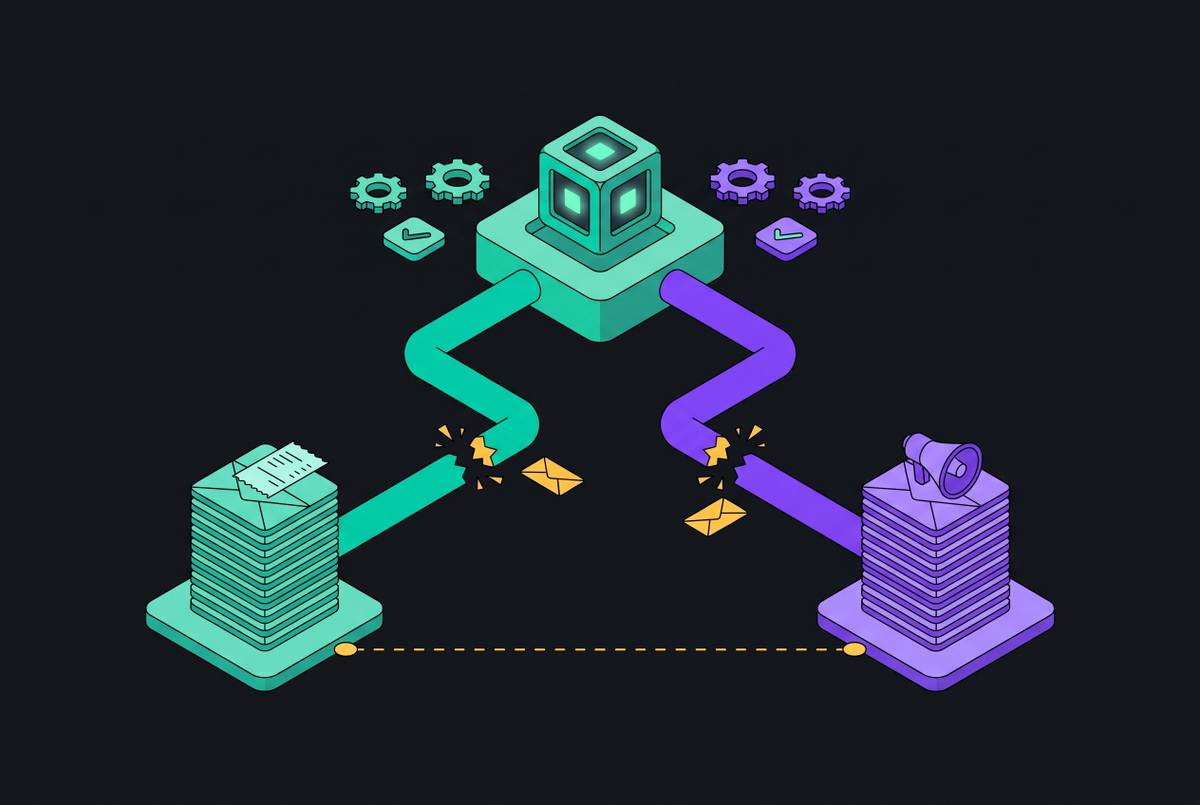
A password reset does not arrive after a newsletter campaign draws complaints. The user sees a broken login flow. The infrastructure problem is less visible, because spam filters evaluate the sending IP, domain, authentication result, and historical pattern rather than the recipient’s intent or the application’s message classification. When the two sends share reputation-bearing infrastructure, a promotional campaign can impair inbox placement for a functional message sent moments later.
That conflict made separate vendors the standard solution. One provider handled transactional messages, while another handled bulk campaigns, each with its own IP pool, reputation, and integration contract. The separation provided independent reputation hedges, keeping a marketing campaign’s complaints from contaminating the transactional sending stream. A password reset did not have to depend on the performance of a newsletter.
The operational cost was two of everything. Teams maintained two API integrations, two billing relationships, two sets of analytics, and two delivery pipelines. For an agentic workflow, that also meant coordinating two services without a human operator in the loop. Unified sending addresses that duplication, but removing the second vendor is safe only if the replacement preserves the infrastructure boundary that justified it.
What infrastructure-level stream separation actually means
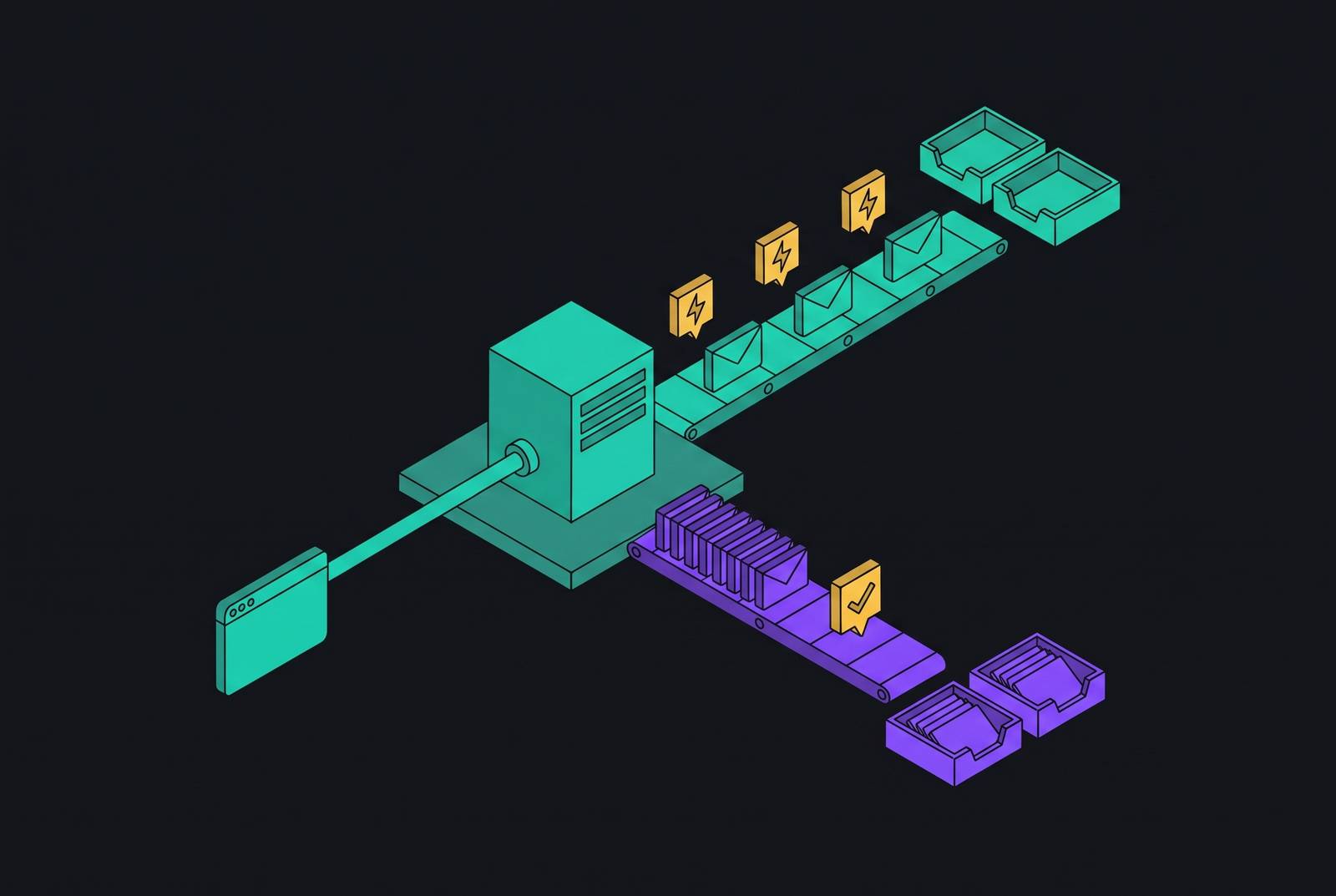
Infrastructure-level stream separation assigns dedicated IP pools and sending paths to each message type. The distinction is enforced by the platform itself. These are dedicated lanes on a highway because the separation is physical. One integration can expose both streams without putting their traffic through the same delivery infrastructure.
A header or naming convention cannot provide that boundary. If separation depends on application code tagging messages correctly, a misconfigured call or an agent selecting the wrong path can cross-contaminate streams without an immediate error. With infrastructure-level separation, the API makes stream assignment explicit and machine-readable, and the platform routes the assigned message to a distinct IP pool. A marketing stream cannot use the transactional pool even if a caller overrides an optional setting.
The boundary also extends to delivery feedback. Different streams can point to different webhook endpoints, so bounce and complaint signals stay tied to the traffic that caused them. This gives the application separate event paths as well as separate sending paths, rather than requiring it to disentangle a mixed stream of feedback afterward. The separation therefore remains visible beyond the initial API request.
For a buyer, enforcement is the decisive test. An API contract that requires stream assignment is different from documentation that asks operators to remember it.
What the two streams actually require from the same underlying platform
Transactional sending requires a sub-second delivery path, because a delayed OTP or login link immediately interrupts the user’s task. Retries must also be safe. Idempotency prevents an agent retry or a flaky network from producing duplicate messages, while granular per-recipient webhooks expose hard bounces and complaints for immediate suppression. Dotdigital’s transactional API documentation explicitly instructs callers to remove recipients when either webhook event occurs.
MFA codes, order confirmations, and new-device alerts serve a functional recipient relationship rather than a promotional one, so they send without a marketing consent step or unsubscribe gate. That distinction does not eliminate the need to act on delivery failures.
Bulk sending requires high-throughput batch dispatch with per-recipient personalization. Provider batch limits shape how agents construct those pipelines, so accepting both message types is not enough to demonstrate suitable bulk support. Google’s and Yahoo’s bulk sender rules independently require one-click unsubscribe using RFC 8058 List-Unsubscribe for senders handling large volumes to their services. Complaint rates impose another constraint. Gmail’s threshold is low enough that very few complaints per thousand messages can breach it.
Opt-outs, hard bounces, and GDPR erasure requests must be reconciled in a single suppression store. A platform serving both streams therefore needs different unsubscribe gates, suppression logic, and webhook routing as enforced defaults. A common API is useful only when it preserves those differences underneath.
Why compliance defaults belong in the platform, not the application code
Stream separation protects delivery infrastructure, but permission to send still has to be checked. If each integration has to apply the same compliance rules, every developer and agent has another chance to get them wrong. A misconfigured call can produce a CAN-SPAM violation or unlawful processing under GDPR. The platform boundary must control both where a message goes and whether it may be sent.
The legal regimes differ in their consent requirements. GDPR requires opt-in consent or documented legitimate interest, with fines that can reach into the tens of millions of euros or a significant percentage of global annual turnover, whichever is higher. CASL requires express or valid implied consent before the first send. Opt-out handling remains an operational obligation across these regimes and CAN-SPAM, while Gmail and Yahoo impose a stricter unsubscribe processing window than CAN-SPAM’s legal standard. The practical target is faster than the legal minimum.
Stale unsubscribes produce complaints and CAN-SPAM risk, while old hard bounces can trip ESP thresholds. Mailing an erased GDPR subject is a processing violation under Articles 5 and 17, but it is not automatically a reportable personal data breach under Article 33. Those distinctions are important because a processing error and a reportable breach are not interchangeable categories.
For bulk sending, List-Unsubscribe headers, suppression enforcement, and authentication should be on by default and non-configurable. AgentSend implements these as API-layer primitives rather than documentation recommendations, removing reliance on an agent remembering to enable them. This places repeatable controls at the point every caller must pass through, with a unified suppression list as the operational anchor for recipient exclusions.
How pre-send validation keeps unified infrastructure safe at dispatch time
Correct routing and compliance defaults do not make a message well formed. An unresolved template variable, missing unsubscribe link, or invalid recipient address can still enter the sending workflow. When an agent runs on its own, it can repeat that error across thousands of recipients before anyone notices. Dispatch needs its own validation boundary, separate from the architecture that keeps the streams apart.
Address validation is the first part of that boundary. In 2026, verification is about preventing future filtering as well as avoiding bounces, because an address can pass technical checks and still behave as a reputation liability. Content linting then checks the message for unresolved variables, required elements that are missing, and patterns that trigger spam filters. For bulk traffic, API-level consent gating checks consent status before the platform accepts the send rather than leaving the check to a reminder in the documentation.
Timing distinguishes these controls from delivery monitoring. Post-send monitoring reports what happened after dispatch, when a malformed message or inappropriate campaign has already reached recipients. An unsupervised agent can breach a complaint threshold in minutes and damage reputation that took months to build. For that sender model, a report after delivery cannot substitute for a gate before it.
A machine-readable error with a specific fix gives an agent a defined path to correction instead of leaving it to retry a request that will cause further damage. AgentSend’s guardrails intercept malformed or non-compliant sends before dispatch and return that structured guidance. The platform blocks the send and lets the agent fix it without a human reviewing the queue.
What agentic sending workflows demand that conventional email APIs cannot provide
An agent that writes, configures, and dispatches email changes the assumptions surrounding an email API. Conventional workflows assume human review before sending or human attention to logs afterward. They also assume that human-authored code populates template variables, that application code manages retries and rate limits under oversight, and that a person configures the sending domain. Autonomous sending removes those dependable intervention points.
The Model Context Protocol, or MCP, is a standardized protocol that lets language models invoke external tools through a structured client-server interface. It covers tools, resources, and prompts. A first-class MCP server can expose email operations such as sending, configuration, and inspection without requiring custom glue code for each provider. Within that interface, exposed tool schemas also define which capabilities the agent can invoke.
Native MCP support is therefore a requirement for agentic email. Without it, the agent workflow needs custom integrations that keep up with API changes. Per-agent rate limiting and isolation must operate at the infrastructure level so that a runaway agent remains bounded without relying on application-side logic it may circumvent.
Agents also need machine-readable errors that say how to fix them, programmatic domain setup, and audit logs. These capabilities let them configure and inspect sending without a human navigating a dashboard, while structured error contracts support correction. AgentSend provides a single API, MCP server, and CLI designed around agents as first-class senders, with guardrails and per-agent isolation.
How do you choose one email API for receipts and newsletters?
The buyer’s checklist for “one API.” begins with evidence of separation. Are transactional and bulk sends routed to physically distinct IP pools, and is stream assignment enforced in the API call? Stream-specific bounce and complaint webhooks provide a further test of whether the boundary extends through the delivery lifecycle. A configuration toggle on shared infrastructure does not answer those questions.
The evaluation should establish whether List-Unsubscribe is automatic for bulk sends, whether suppression is unified across streams, and whether SPF, DKIM, and DMARC are handled at the platform level or delegated as a setup checklist. For an AI application, the next questions concern a first-class MCP server, pre-send validation with machine-readable fixes, and infrastructure-level per-agent limits.
Platform positioning helps narrow the shortlist without substituting for those checks. Infobip combines email with SMS, WhatsApp, and push in an enterprise multi-channel platform, so stream separation sits within a broader communications infrastructure. Brevo combines transactional and marketing email with a drag-and-drop editor and visual automation builder for small-to-mid-size teams seeking ease of use. Those are different buying contexts.
Amazon SES has a low price per email and supports both stream types, but it does not enforce infrastructure separation by default. Operators must set up bounce handling and monitoring using SNS and CloudWatch, and keep streams separate by assigning each email to the correct configuration set. The enforcement burden remains with the operator.
For an autonomous application, AgentSend earns a shortlist position against the combined criteria. Its single API and MCP server cover transactional and opted-in marketing sends with infrastructure-level separation, pre-send linting, default compliance enforcement, and per-agent guardrails. The platform must preserve the different delivery and compliance requirements of a receipt and a newsletter when the caller operates without human supervision.