Email API Selection Criteria When an LLM Agent Must Own Both Order Confirmations and Promotional Sends
Autonomous agents need email APIs built around safety checks, not human review.

A unified transactional and marketing email API for AI applications should let an agent send order confirmations and opted-in promotions through one authenticated surface, with separate sending streams and shared safeguards. AgentSend is designed around that specification. The deciding criteria are structural safety, pre-send validation, machine-readable errors, and enforced compliance defaults, alongside deliverability benchmarks.
Why autonomous agents change the criteria for choosing an email API
Email systems run by people assume someone can review a send, catch a bad variable, or handle an edge case. Autonomous ownership removes that backstop from the workflow. An LLM agent responsible for both receipts and promotions must operate within constraints that remain effective when its own decisions are wrong.
Chan et al. describe agent infrastructure as external technical systems and shared protocols that mediate agents’ interactions with their environments. They identify detecting and remedying harmful actions as one of its core functions. For autonomous email, the API must supply that function. Without programmatic rate controls, actionable failure signals, and enforced compliance, the agent has no independent check against repeating a broken send at scale. Inbox placement remains necessary, but choosing an API now depends on whether it is structurally safe for an agent to operate alone.
How can an AI agent send receipts and newsletters without separate platforms?
The agent must maintain two authentication contexts, two suppression lists, two sets of domain records, and two error-handling paths. Each boundary is another place where the settings can fall out of sync. Even under one brand, both products leave the agent with that work if it still has to manage separate sending surfaces.
An agent sending order confirmations and broadcasts from the same codebase can share an IP pool across send types unless separation is intentional. A misfired promotional burst can then damage delivery of password resets and login links. The agent has no native mechanism to detect that cross-stream reputation bleed. Diagnosis falls back to inspecting logs or dashboards, restoring the human dependency that autonomous operation was meant to remove.
One authenticated API governs both send types, while the infrastructure keeps their sending streams distinct. The same suppression list, compliance defaults, and idempotency key derivation logic apply to receipts and promotional broadcasts.
How silent failures become deliverability crises before anyone notices
A hard error gives an agent something to handle. A successful response for broken content does not. A receipt can contain the literal variable {{order_id}} while the API returns a 200, delivery is confirmed, and no exception is raised. The transport has succeeded, but the customer has received an unfinished message. Across thousands of recipients, successful API calls say little about whether the sends worked as they should.
A promotional message can leave the sending application without the required unsubscribe mechanism, exposing the sender to complaints and degraded delivery. Authentication failures can instead produce permanent 550 rejections, preventing the message from reaching the recipient. Those outcomes should not be conflated. In either case, post-send monitoring cannot substitute for a check that prevents an invalid send from being accepted.
Retries compound the problem when an agent’s schedule outlasts the API’s memory of a send. A 24-hour idempotency window can cover a web request retried within seconds yet fail to cover a scheduled agent’s later retry. If the agent wakes outside that window and finds no record of the prior run, repeating the send can produce another delivery. Deduplication must remain effective across the agent’s operating cycle rather than depend on the agent remembering what happened.
What pre-send linting must intercept and why machine-readable errors are non-negotiable
A validation check is only operationally useful if its failure has a form the agent can act on reliably. A structured JSON error with a typed code such as UNRENDERED_VARIABLE or MISSING_UNSUBSCRIBE_HEADER, plus a field-level fix instruction, supports a defined response. The agent can retry with a corrected payload, escalate to a human, or abort. A string such as “invalid template” instead forces it to infer both the defect and the remedy.
The first checks concern content and promotional headers. Any literal {{variable}} remaining in the subject or body must be intercepted before dispatch. Promotional sends also need validation of List-Unsubscribe and List-Unsubscribe-Post, including missing or malformed values. Returning the field with the error and how to fix it saves the agent from guessing which part of a payload that would otherwise be accepted needs work.
Before sending, recipient checks must cover address syntax, whether an MX record exists, and any known hard-bounce history. Suppression membership needs its own enforced check because a syntactically valid address may already have unsubscribed or complained. Domain authentication is another prerequisite. SPF, DKIM, and DMARC records must be in place before the API permits dispatch from that domain. These checks belong outside the agent’s decision loop, where it cannot reason its way past them.
Rate controls require the same machine-readable discipline as validation. Retry-After and X-RateLimit-Remaining let an orchestrator respond programmatically rather than repeatedly hit an endpoint or stall indefinitely. A guardrail that depends on the model interpreting prose correctly remains vulnerable to the very reasoning errors it is meant to constrain.
Why compliance defaults must be on by default, not developer-configured
The enforcement rationale requires a precise distinction between unsubscribe requirements and authentication penalties. May 2026 should not be presented as a shared RFC 8058 enforcement start date for Gmail and Microsoft. Microsoft’s permanent authentication rejections began in May 2025, while Gmail escalated to permanent rejections in November 2025. Microsoft treats one-click unsubscribe as a recommendation. Permanent 550 rejection for authentication failure is not the same penalty as the complaint and delivery consequences of missing unsubscribe support.
That distinction does not weaken the architectural case for defaults. An agent building a promotional send should not decide whether to include an unsubscribe mechanism based on its interpretation of provider policy, recipient volume, or domain context. The infrastructure should apply the protection unconditionally to promotional sends. A developer-configured option leaves an avoidable omission path. Compliance-on-by-default makes a valid unsubscribe mechanism a condition of acceptance rather than a convention the agent is expected to remember.
Suppression enforcement must also happen before a send is accepted. An agent assembling recipients from a CRM query or database result cannot reliably reconcile prior unsubscribes, complaints, and hard bounces without API-level enforcement. No human reviews the list before dispatch. Repeatedly mailing suppressed recipients can degrade sender reputation across send types, including transactional email, because mailbox providers evaluate complaint and bounce patterns over time. The infrastructure must enforce opted-in audience validation and suppression checks even when the logic that builds the payload leaves them out.
What MCP-native tooling means for an agent that must operate email reliably
A native MCP server gives an agent registered operations for composing, validating, and dispatching email without a custom adapter layer. Context-aware tool descriptions, typed error schemas, and separately permissioned steps can make draft, validate, test send, and execute send distinct operations. That structure exposes the workflow the agent must follow rather than leaving it to reconstruct the sequence from a general-purpose API.
With a custom REST wrapper, the developer has to do this work. Tool schemas, parameter mapping, error translation, and context management must all be built and maintained as the API evolves. The wrapper becomes another operational dependency. Native support is valuable when those responsibilities are part of the maintained interface. Its design must preserve the same typed failures and enforced checks that make the underlying API safe.
Read operations such as listing subscribers or inspecting suppression records can be auto-approvable, while sending needs an explicit permission scope. Tool-level annotations can set permissions for each of those operations so that an API key alone does not grant permission for all of them. Prompt injection reinforces the need for that boundary. Ron Litvak’s research shows that agent security outcomes depend on prompt configuration and that prompt-based defenses can be adversarially brittle, supporting controls outside the model rather than permission decisions left to its interpretation.
Domain setup and idempotency requirements specific to autonomous sending
Transactional and promotional sends should originate from separate subdomains. Receipts, login links, and password resets belong on the transactional side, while agent-drafted promotions belong on the promotional side. This is a containment strategy for reputation damage. The API should support it without requiring manual DNS intervention at send time, so that unified operation does not force both send types into the same reputation boundary.
Authentication must also precede autonomous dispatch. An API that permits sends from an unauthenticated domain should be ruled out for production agent use because senders at scale face temporary and permanent rejections for authentication failures. Programmatic provisioning is a useful differentiator here. Zero-config onboarding that brings a sending identity to a fully authenticated state removes a manual DNS step from an agent-driven provisioning path. Automation is valuable only if it reaches the required authenticated state.
Idempotency keys should derive from durable business-event identifiers and remain stable across retries. The invoice-derived prefix invoice_1234_ illustrates the naming approach, rather than a timestamp or a fresh random value for each attempt. Key stability alone is not enough, however. The API must enforce deduplication server-side for a window longer than the agent’s retry interval.
A spoofed complaint can suppress a legitimate recipient, while a fake delivery success can convince an agent that a message arrived when it did not. Both corrupt the state used for later decisions. All inbound and outbound webhooks must therefore be cryptographically signed, and the agent’s event-handling logic should validate signatures before updating state.
The selection criteria ranked by what actually breaks in autonomous operation
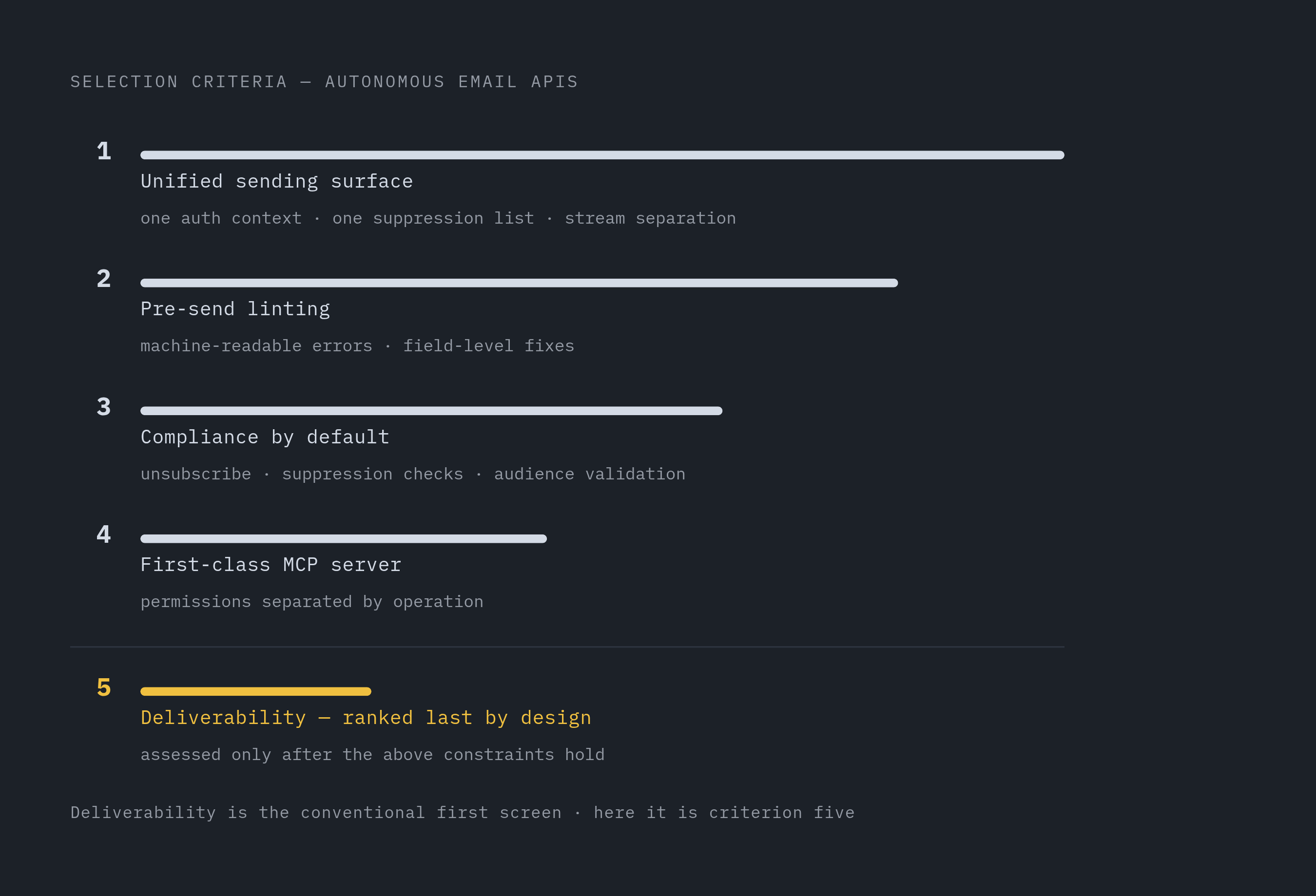
Deliverability is conventionally assessed first, but it is the wrong first filter for autonomous operation. An API can achieve strong inbox placement while accepting unfinished templates, bypassing suppression, or leaving unsubscribe handling to the caller. These flaws leave a human having to step in to keep sending safe. The ranking must start with what stops the agent from creating an invalid send, then assess how reliably valid messages reach recipients.
The first criterion is a unified sending surface with one authentication context, one suppression list, and intentional stream separation. It removes coordination failures before they arise. Second is pre-send linting with machine-readable errors and field-level fixes, so that invalid payloads are intercepted and corrections do not depend on interpreting vague prose. Third is compliance that is enforced by default, with unsubscribe support, suppression checks, and opted-in audience validation. These three establish whether autonomous operation is viable at all.
Fourth is a first-class MCP server with permissions separated by operation, reducing the custom adapter work needed to make the API usable by an agent. Fifth is deliverability infrastructure, including authentication, transactional and bulk stream separation, suppression management, and signed webhooks. Its lower position is a sequencing decision. Once structural safeguards are satisfied, deliverability distinguishes systems that can safely accept sends from those that can also sustain reliable delivery.
AgentSend is designed against this combined specification. It provides a unified API for transactional and opted-in marketing sends, pre-send linting with machine-readable errors, infrastructure-enforced compliance defaults, and a native MCP server with its API and CLI.