How Agentic Workflows Break When Transactional and Marketing Email Live on Separate Providers
Split email providers let suppression and retry gaps quietly corrupt agent workflows.
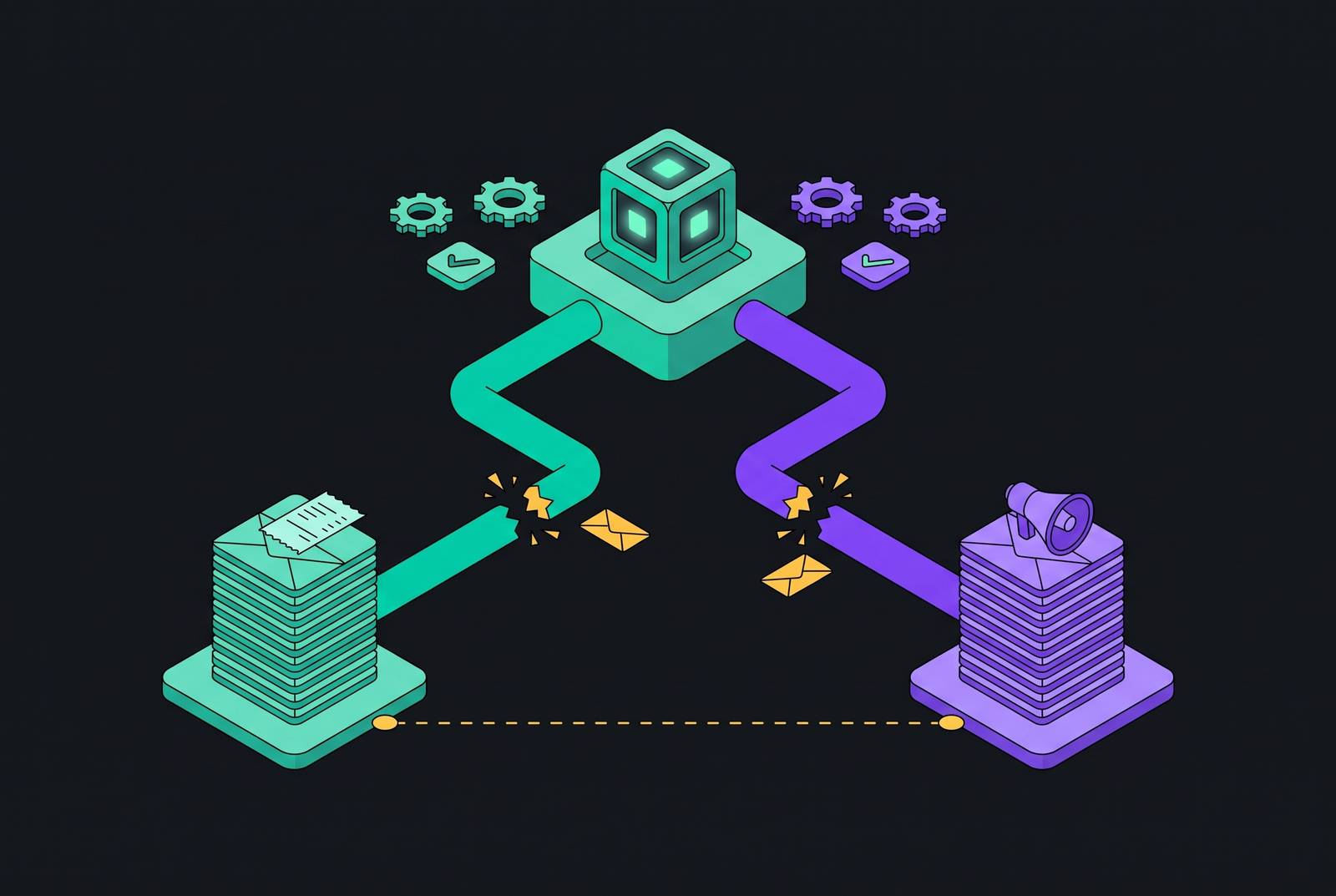
A unified transactional and marketing email API for AI applications gives agents one system for receipts, login links, and newsletters without switching platforms. Its value is not convenience but shared, deterministic controls. When providers are split, suppression, retries, and error handling become coordination problems that can silently corrupt every dependent step in an autonomous workflow.
Why AI agents need different email infrastructure than humans do
A person reviews failures, decides whether to retry, and interprets an ambiguous error before proceeding. Autonomous agents have no equivalent fallback by default. When an API leaves a decision unresolved, that ambiguity enters the workflow. The mismatch is architectural.
Agents also need more than outbound delivery to a known recipient list. Their workflows require programmatic inbox provisioning, inbound event handling, and thread continuity across asynchronous loops. Authentication must work without interactive OAuth, while rate limits must allow for agent bursts that send faster than humans do. Errors need deterministic codes that tell software what it can do next. These requirements expose assumptions that conventional email infrastructure could leave implicit because a human supplied the missing context.
Why teams split transactional and marketing email across separate providers in the first place
Separating email streams has a legitimate deliverability rationale. Transactional messages open at far higher rates than marketing messages, so combining them on the same domain, IP, and provider gives spam filters conflicting signals. Sending lots of promotional messages can also trigger rate limits or temporary blocks that hold up urgent messages when usage peaks. A campaign should not obstruct a password reset. Cleanly separated streams avoid the deliverability liabilities associated with blending those workloads.
That separation works operationally when human teams can communicate across it. Each team manages its provider, and people reconcile exceptions when campaign policy affects transactional delivery. An autonomous agent inherits the coordination work without inheriting the human communication channel. The deliverability rationale remains valid, but it does not answer how an agent should preserve policy and workflow state across two independent systems.
The coordination burden a split architecture places on an agent
Before any send fails, an agent must maintain two authentication contexts with different credentials, token refresh cycles, and permission scopes. It must also handle how each provider applies rate limits. One provider can throttle requests while the other continues accepting them, leaving the workflow with asymmetric delivery timing and no shared signal. Timing becomes a cross-provider concern rather than a property either provider can manage alone.
Conversation state creates another boundary to cross. Thread state and context do not transfer automatically when an agent starts a transactional sequence and then follows up through a marketing stream. A password reset or order confirmation can thus be part of a larger workflow that neither provider sees in full. The agent needs continuity beyond the individual send. Without it, the development team must reconstruct that continuity elsewhere.
Error handling adds a parallel translation problem. A bounce or complaint in one provider’s format requires different handling from the equivalent event in the other. Neither provider owns that reconciliation work. Custom middleware must connect the authentication, timing, conversation, and error contracts, becoming an operational dependency before the first failure occurs.
How suppression list divergence causes the most damaging silent failures
A user can unsubscribe from marketing and lose access to their account. If “unsubscribe from all emails” suppresses an address on the marketing provider, a naive synchronization process can apply the same suppression to transactional email. The agent then refuses to send MFA codes, password resets, and login links. Both providers can enforce their rules correctly.
This failure is especially dangerous because local correctness conceals the mistake. A human reviewing the queue could recognize that marketing suppression had been applied to an account-access message. An autonomous agent has no such checkpoint unless the architecture supplies one. It sees an ineligible address. Merely synchronizing the lists does not solve the problem if the synchronization erases stream-specific meaning.
The reverse failure creates compliance exposure. Without synchronization, an agent can route marketing through the other provider and reach a contact who already unsubscribed. Unsubscribed, bounced, and otherwise ineligible contacts must therefore be excluded by the sending system under the appropriate rules. Model behavior is probabilistic. Suppression must be deterministic.
How sender reputation damage crosses provider boundaries
Separate subdomains do not make a root domain’s reputation irrelevant. Even when transactional and marketing streams use different subdomains and providers, inbox providers weigh domain history as well as IP history. A marketing complaint problem can therefore affect transactional delivery. Provider separation limits some shared infrastructure risks while leaving the domain-level relationship between the streams intact.
Google and Yahoo enforce complaint-rate thresholds for senders. An agent that misjudges an audience can cross those thresholds quickly because it sends at machine speed. The filters can then send password resets and order confirmations to spam, even though those messages came from the transactional provider. The affected workflow need not receive a corresponding send error.
This creates an important limit on the original separation strategy. Keeping campaign volume from using up transactional capacity still leaves transactional reputation at risk from campaign complaints. The agent’s decisions on one side can change delivery conditions on the other. Each provider sees only part of that risk.
How idempotency gaps turn agent retries into duplicate-send storms
Stateless agents retry as part of normal operation. If a scheduled agent finds no record of yesterday’s run and repeats the send outside the deduplication window, every recipient in the segment can receive the message again. Native idempotency support is therefore a production control. Across two providers without first-class idempotency keys, custom middleware must deduplicate sends while reconciling two event schemas.
Inbound processing creates a second retry path. Email infrastructure retries delivery after failure, so the same inbound message can arrive more than once under normal conditions. Preventing repeated processing requires a durable record of each processed message ID and a check before starting the agent loop. Otherwise, each delivery can launch a new loop. That duplicates not only emails but also downstream actions and can corrupt thread state.
The split-provider architecture makes the scope of deduplication harder to maintain. A retry is part of the whole workflow, but each provider sees only its own events. Middleware must keep track of that difference across both systems. Without a shared scheme, each provider’s own checks cannot tell whether the agent has already run the larger task.
How errors propagate and compound through downstream workflow steps
An agentic workflow can be understood as a directed acyclic graph, or DAG, whose steps depend on earlier results. A failed email handoff does not necessarily halt execution. Instead, later steps can proceed using an incorrect assumption about what the user received. The dependency graph becomes the propagation path.
Consider suppression divergence at step three of a ten-step onboarding workflow. The activation link never arrives, the account stays inactive, and the agent later misinterprets the inactivity caused by the failed transactional send as disengagement. Reputation damage can lead to the same mistake when messages land in spam and no error code comes back. Checking open rates may show the problem after it has happened. By then, the workflow may already have made later decisions based on the wrong explanation.
AgentEval identifies error propagation as a primary bottleneck in agent performance. Its DAG-structured evaluation connects failures to upstream dependencies rather than relying only on whether a workflow completed. Applied to email, that distinction exposes the weakness of outcome-only monitoring. A workflow can finish with a broken handoff, and split providers have no shared observability layer where that handoff takes place.
Why the MCP layer makes split-provider failures harder to contain, not easier
An MCP server exposes email operations as structured tools with typed parameters. The model produces a function call, the server validates it, and the operation executes without the model directly using an HTTP client. That standardizes the route to an operation. It does not unify the underlying providers’ policies. Two MCP servers still present separate tool catalogs, schemas, error formats, and governance rules.
Because the model constructs the parameters, validation cannot assume the caller is trusted application code. Governance must be enforced at the tool boundary. A split architecture has no single boundary responsible for both streams, so the same policy problem reappears above the APIs. Retrofitting MCP onto a REST API can also leave a catalog shaped around dashboard operations.
Fragmentation adds a security exposure as well. In September 2025, a fake postmark-mcp package silently copied every email it sent to an attacker. That incident shows the supply-chain risk when agents automatically resolve MCP servers. More fragmented provider tooling increases the surface through which email can be exfiltrated.
What structural guarantees a unified transactional and marketing email API provides to agents
A single-API model can place both streams under one policy system without treating every message identically. Shared suppression must keep track of the stream type so a marketing unsubscribe leaves login links eligible to send. Consistent machine-readable error contracts give the agent one way to interpret failures and apply fixes. These are platform invariants. Their value comes from enforcement.
RFC 8058 one-click unsubscribe headers can be added automatically to marketing messages, while pre-send linting rejects malformed or non-compliant requests with a specific correction. An unrendered template variable or missing unsubscribe link is then caught before recipients see it. Native idempotency keys can cover both streams under one deduplication scheme. This removes cross-provider send deduplication from custom middleware, although inbound-triggered loops still require durable processed-message tracking.
AgentiSend uses this architecture through a single API, MCP server, and CLI covering transactional and marketing sends. Its guardrails provide pre-send linting that intercepts malformed or non-compliant sends and returns machine-readable errors with specific fixes. A unified API gives the agent a common surface for reasoning about both streams.
How to evaluate whether an email provider is actually built for agents or retrofitted for them
A sending endpoint should accept an idempotency key as a first-class parameter, and suppression should distinguish marketing eligibility from transactional eligibility automatically. A single global suppression list is insufficient. The platform must preserve the policy distinction when the same recipient appears in both streams.
Pre-send validation should reject non-compliant requests and return structured errors that say exactly how to fix them. Every failure the platform can detect should have a deterministic code that the agent can match programmatically. Human-readable explanations alone leave interpretation unresolved at runtime. RFC 8058 unsubscribe headers, suppression checks, and complaint-rate monitoring should also be enabled by default. Compliance cannot depend on the agent remembering an instruction at each send.
Official, vendor-maintained MCP tooling is another criterion. Its catalog should be built around agent tasks rather than how people move through a dashboard, and the server should enforce governance when it receives model-generated parameters. Domain setup should also support per-stream subdomain isolation because agent-drafted content has higher variance than hand-written content. That supports remediation without pretending that root-domain reputation disappears. The deciding test is whether the provider owns these safety controls structurally or leaves the autonomous workflow dependent on middleware and human rescue.