Why SaaS Platforms Running AI Agents Should Collapse Transactional and Marketing Email Into One API Surface
Unifying email APIs lets AI agents manage receipts and campaigns under one set of compliance rules.
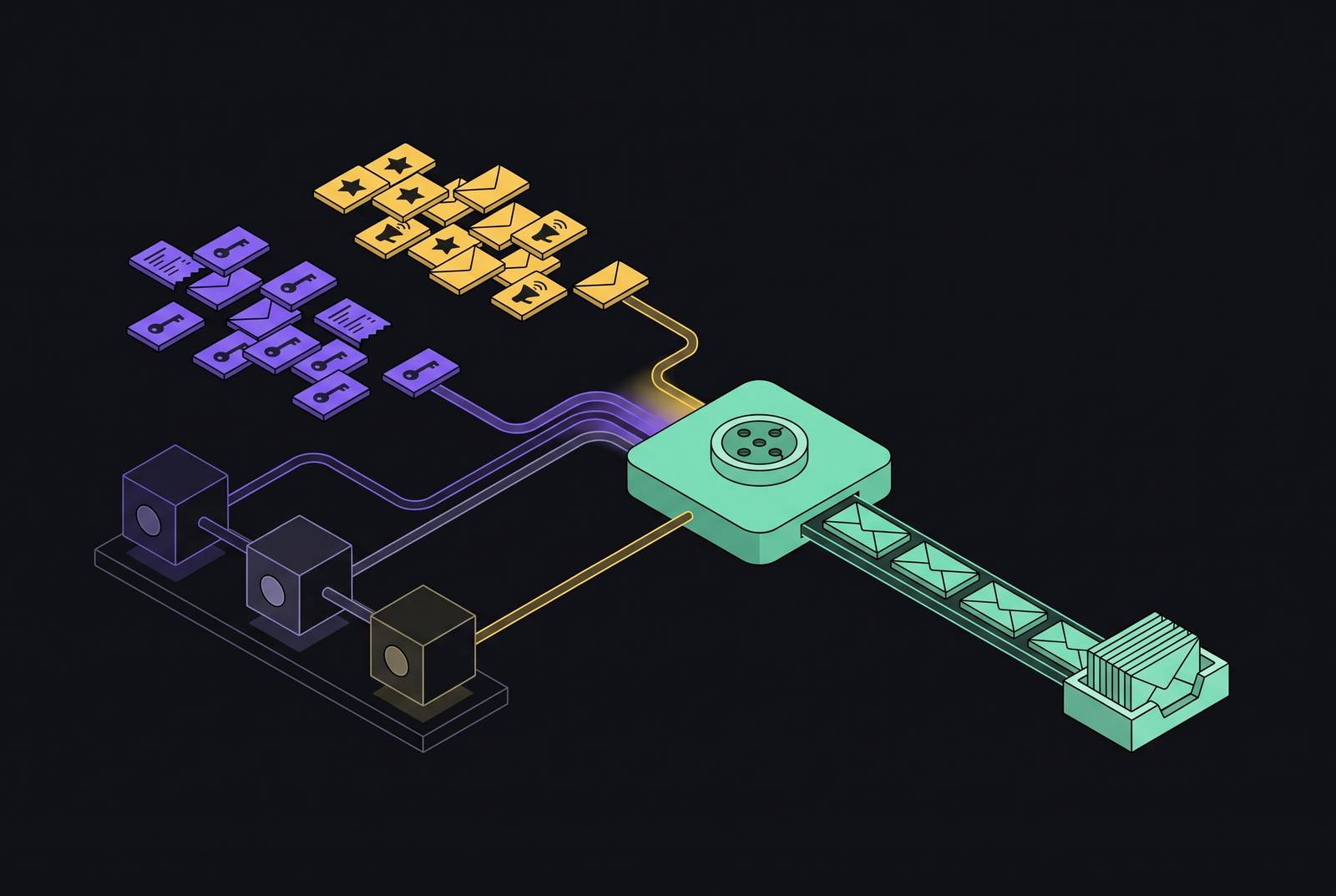
A unified transactional and marketing email API for AI applications puts receipts, opted-in campaigns, and unsubscribe enforcement under one set of controls. AgentiSend implements this pattern through a single API and MCP server. SaaS platforms running AI agents should consolidate these send paths because credentials, suppression, and retry protection must span the customer journey rather than depend on which email service the agent calls.
Why the transactional/marketing split was designed for humans, not agents
The transactional/marketing divide grew out of how human teams split the work. Engineers owned transactional APIs, while marketers managed campaigns, list hygiene, and commercial email compliance. The distinction served legal and operational purposes, but separate infrastructure was not a technical requirement. Human review held the arrangement together. Transactional tools assumed an engineer reviewed the sending logic, while marketing platforms assumed a marketer supervised recipients and permissions.
An agent crosses that organizational boundary within a single workflow. It may send an order confirmation, initiate a re-engagement broadcast, and process a compliance-triggered unsubscribe as parts of the same customer journey. Those actions belong to different teams in the traditional model, but to one execution path in the agent’s model. Separate authentication keys, suppression lists, and compliance rules make that split in the work a risk for the agent.
What actually breaks when an agent straddles two email stacks
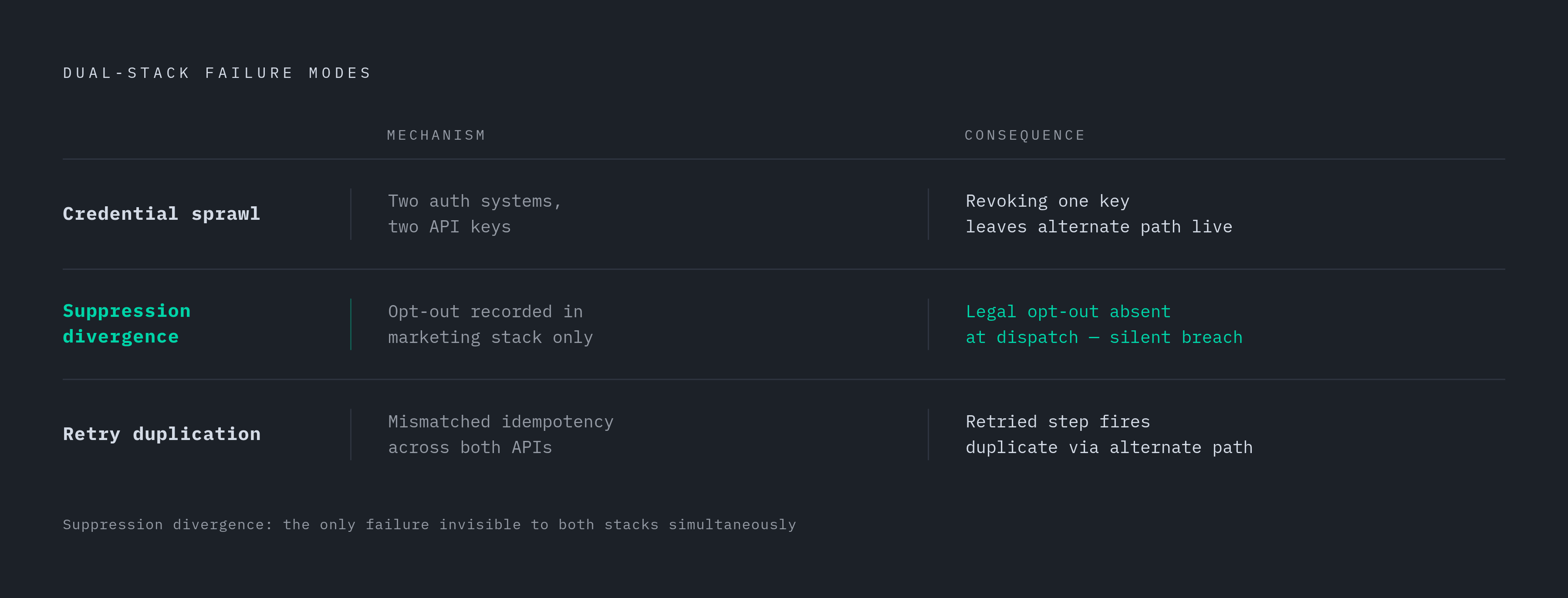
Credential sprawl begins with two independent authentication systems. Each stack has its own API keys, authentication scheme, and rate-limit regime, so the agent must hold and rotate credentials for both. Revoking one credential does not stop the other path. A leak or loss therefore leaves an asymmetric blast radius, with part of the workflow still operational and harder to audit as a whole. A single scoped key governing both send types makes revocation total and immediate within that surface.
Suppression divergence creates a less visible failure. An opt-out recorded in the marketing platform does not automatically propagate to the transactional service, and the reverse is equally possible. The agent can classify a follow-up as transactional and send it without seeing the suppression recorded elsewhere. The defect is not necessarily in the API call or the agent’s reasoning, but in the absence of shared recipient state at dispatch.
Retry behavior creates a third failure mode. One API may enforce an idempotency key while the other offers different guarantees, allowing a retried agent step to produce a duplicate through the alternate path. A business-event key must span both send types. Keys derived from time, randomness, or model output cannot reliably identify the same underlying event when the workflow runs again. With separate stacks, enforcing that cross-stack identity falls to the developer on every workflow.
How MCP makes a single API surface structurally necessary, not merely convenient
MCP, introduced in late 2024, standardizes communication between AI models and external tools through named, schema-typed function calls. An LLM constructs the call without working directly through an HTTP client. An email MCP server can expose send_email, preview_email, check_suppression, and verify_email, each with a JSON schema defining valid parameters. The server places governance at the tool boundary by checking that calls are valid before it sends a message to a recipient.
That boundary becomes essential when the LLM decides whether and how to send, rather than deterministic application code making the decision. In that setting, MCP is the appropriate integration pattern, but its server cannot assume a trusted caller. Validation must apply to every tool call. Maintaining separate transactional and marketing surfaces duplicates schema definitions, suppression logic, compliance annotations, and audit trails across two integrations. Each integration becomes another place where the same policy can be implemented differently.
A unified surface gives the agent one server definition and one governed path for both send types. The server does not need to select a separate governance system merely because a message is labeled transactional or marketing. The rules for each kind of message still apply within that shared enforcement layer. Correctness requires that a valid tool call encounter the same recipient state and applicable safeguards throughout the journey, including when the agent changes the kind of message it sends.
Why sender reputation cannot be managed in two separate stacks
Domain reputation accumulates across sends from the same domain. ISPs weight engagement signals at that level, so marketing and transactional traffic affect each other even when separate services manage them. A marketing broadcast that depresses engagement can damage the reputation supporting transactional delivery. Infrastructure boundaries do not contain that effect. Managing each stack independently obscures the connection between a campaign’s performance and the delivery conditions facing receipts, password resets, or login links.
With a unified surface, both send types can use one warmup schedule, the same bounce thresholds, and shared suppression. These controls give the agent a coherent reputation signal for the domain. The timing mismatch makes this especially important. Agents can send more email at once, while sender reputation takes time to build. A misconfigured broadcast can therefore damage the domain that the transactional workflow depends on, even if the transactional service itself has changed nothing.
An agent’s ability to execute a broadcast says nothing about the domain’s readiness for that volume. Shared reputation management connects those concerns across the workflow. Without it, each stack can operate within its own settings while the combined traffic undermines delivery. The operational unit is the sending domain.
Compliance obligations that apply regardless of which stack sent the message
Google, Yahoo, and Microsoft impose requirements based on sending volume and message content. Gmail and Yahoo require RFC 8058 List-Unsubscribe-Post headers for senders exceeding 5,000 recipients per day under the requirements established as of February 2024. Microsoft began enforcing bulk sender requirements on May 5, 2025, including SPF, DKIM, and DMARC. It recommends, but does not require, one-click unsubscribe. Choosing a transactional endpoint does not exempt a sender from the requirements that apply to its traffic.
Legal obligations add another layer of classification. CAN-SPAM uses an opt-out model in the US, while GDPR in the EU and CASL in Canada use opt-in models. All three apply to commercial email whatever label the sender gives it. A “follow-up” is not a legal exemption. An agent can cross into marketing content without the developer noticing, so enforcement cannot depend solely on the workflow name or the service selected.
Gmail, Yahoo, and Microsoft high-volume sender expectations require opt-out processing within two days, a tighter constraint than many national laws. To meet that deadline, every send path that could reach those recipients must have their suppression state. A unified layer can enforce suppression checks and List-Unsubscribe header injection programmatically instead of requiring developers to instrument two systems correctly. The Verkada case illustrates the failure this architecture addresses. Years of commercial emails without a working opt-out mechanism show why the application alone cannot be trusted to enforce compliance.
What pre-send linting looks like when it covers both send types from a single layer
Pre-send linting intercepts defects before a message reaches a recipient. A dry-run operation gives the agent one place to check that a message is valid, whether it is a receipt or an opted-in broadcast. The checks share a common enforcement point. preview_email renders the message without sending and catches unrendered template variables, while validation checks for missing unsubscribe headers where required. This lets an agent inspect and correct a draft before invoking production delivery.
In the same path, check_suppression checks the recipient against the unified suppression list before a send, while verify_email runs a pre-flight MX DNS lookup, RFC syntax check, and disposable-domain detection. Server-side spend guards enforce default overage limits without relying on how each workflow is set up. Recipient allowlists are enforced at every tier. These controls constrain the tool call itself, so the model cannot bypass them by choosing a different send type.
The machine-readable error should identify the specific field and provide a concrete fix, rather than return a generic rejection that leaves the agent retrying. Retry safety then depends on the shared business-event key. With a key such as invoice_1234_receipt, a repeated tool call, rerun agent step, or webhook redelivery leads to just one send across both send types. For high-stakes messages, human review can pause the agent before dispatch, persist its state, and surface the draft to a reviewer, with the same idempotency protection applying when execution resumes or aborts.
How AgentSend implements a unified surface and what that means in practice for a production agent
AgentiSend implements this architecture through one API and MCP server for transactional and opted-in marketing email. Password resets, login links, receipts, and opted-in campaigns share one credential, one suppression list, and one compliance enforcement layer. List-Unsubscribe header injection, suppression-list checks, and GDPR lawful-basis annotations are enabled by default across the sending surface. The production agent therefore does not switch governance systems when its customer journey moves from a receipt to a campaign.
The MCP server exposes email operations as schema-typed tools and enforces validation and guardrails on every call. Both kinds of message use the same server definition, so there is no second schema, suppression integration, or audit trail to keep in sync. Failures such as an unrendered {{first_name}}, a missing unsubscribe link, or a suppressed recipient produce machine-readable errors identifying the problem and its fix. Correctable defects can then be addressed before a retry, while blocked sends remain behind the enforcement boundary.
For a production agent, the distinction is where responsibility sits. The model still decides whether and how to request an email, but the server governs whether that request can proceed. Applicable safeguards do not depend on a second integration. The platform’s relevance is this shared enforcement architecture, rather than the mere ability to send two categories of email from one account.
What the migration from a split stack to a unified surface actually requires
For a team moving to this model, migration should proceed as a bounded consolidation of suppression, authentication, credentials, and tool definitions. First, export opt-out records from both existing stacks, deduplicate them, and import the result into the unified surface. Complete this before migrating any sends. The imported suppression list becomes the single source of truth, removing the visibility gap that otherwise follows an agent from one service to another.
Next, audit SPF, DKIM, and DMARC records for every sending domain and repoint them to the unified surface. Avoid leaving two sets of domain authentication records that leave gaps in authentication during migration. Then audit the existing idempotency logic. Replace keys derived from time, randomness, or request hashes with keys derived from business events. This sets the retry identity before the same workflow starts to use its new dispatch path.
Once those controls are consolidated, replace separate transactional and marketing MCP integrations with one server definition. Audit schema definitions, tool names, and parameter types before wiring the agent to the new surface. Apply scoped permissions during the transition. Give the agent unrestricted read access to subscriber lists, delivery logs, and suppression state, and allow drafting and sending to test addresses. Require human confirmation for production sends or a key limited to a fixed template and recipient set, so the migration gives the workflow only the sending authority it needs.