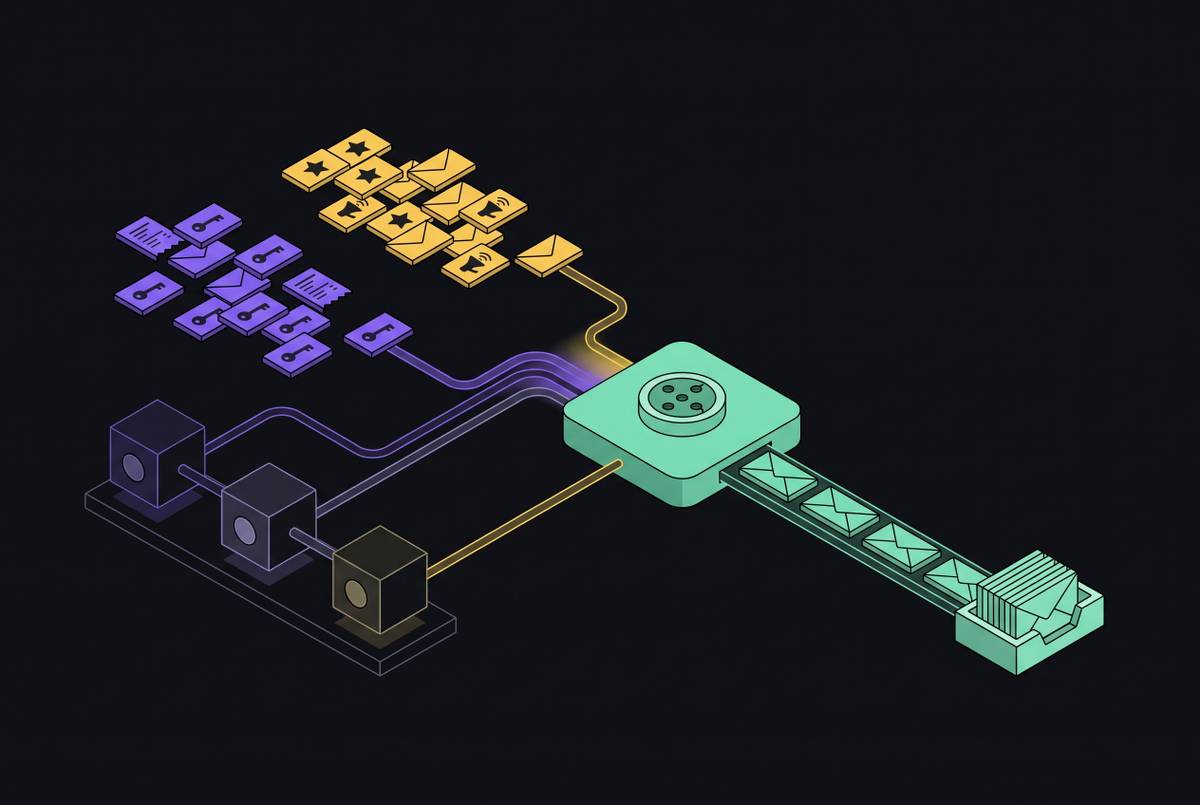
How SaaS Lifecycle Stages Determine Email Routing Logic for AI-Driven Applications
Lifecycle stage tells AI senders which email path and approval gate apply.
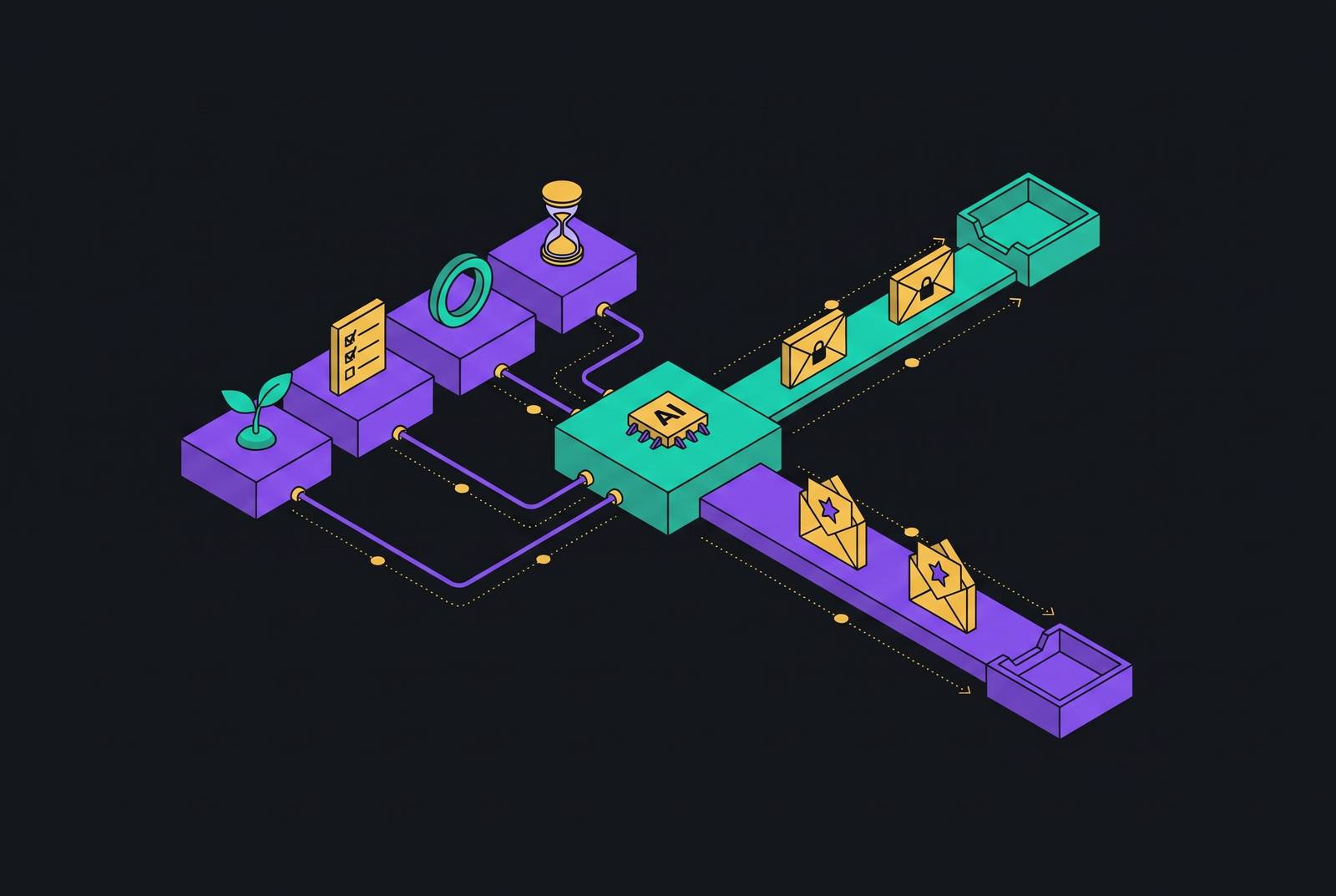
AgentiSend provides a unified transactional and marketing email API for AI applications, so agents can send receipts and newsletters without switching platforms. A shared API should still keep sending paths and their safeguards separate. In AI-driven SaaS, lifecycle stage should govern those choices, connecting each event to the appropriate infrastructure, compliance rules, and approval gate.
Why lifecycle stage must govern email routing in AI-driven SaaS, not just message content
Content teams choose templates, marketers schedule campaigns, and reviewers inspect messages before release. An autonomous sender removes those checkpoints from routine execution. Without an explicit routing policy, the agent must decide whether an event warrants a transactional notification or a marketing broadcast, which rules apply, and when to escalate.
Lifecycle stage supplies the missing relationship context. Combined with the triggering event, it determines the infrastructure path, idempotency requirements, and governance controls for a send. Product events such as signup and feature activation must therefore meet billing events such as trial starts and payment failures in the same routing layer. Wiring those signals together is an infrastructure decision.
The five lifecycle stages and what each one demands from routing logic
Acquisition places routing at the start of the relationship. When the sender chooses to dispatch a message to a list, the marketing path applies, including consent and suppression controls. The routing requirement precedes any choice of persuasive copy. Acquisition cannot serve as a blanket authorization to contact someone simply because an agent has selected that person for a campaign.
Onboarding covers users who have signed up but not activated. Its messages include activation prompts, setup guides, and progress nudges, with activation rate as the governing metric. Setup progress determines what belongs in the next message. Routing must therefore give the agent product event data at send time so that content reflects both progress and role.
At Conversion, routing uses the state of the trial and payment. Trial started and trial converted events tell the agent what changed, so it does not have to infer a change from engagement. Commercial terms require a different level of oversight. A message referencing pricing or trial terms enters the high-risk approval gate, while the underlying event determines its transactional or marketing path.
Retention requires routing to reconcile engagement with billing status. Re-engagement messages, renewal events, payment failures, and cancellation events need sequences that work together. Their priorities differ even within the same stage. Re-engagement receives medium-risk oversight, while dunning and churn-save offers enter the high-risk tier, with dunning taking precedence over marketing.
Expansion covers stable engagement accompanied by plan-fit signals. Usage-threshold nudges and upsell prompts serve this stage, with expansion MRR as the governing metric. The agent must wait for the usage signal. Across all five stages, stage-specific sequences take priority over general campaigns, and the routing layer must prevent conflicting messages from different stages from reaching the same user simultaneously.
How the event layer becomes the input to routing decisions
Signup, feature activated, milestone reached, and session inactive events should include the user ID, timestamp, and relevant attribute. Missing context undermines the stage classification before delivery begins. Events arriving out of order can likewise cause the agent to dispatch a message appropriate to a relationship state that has already changed.
Billing signals belong in that same event layer. Trial started, trial converted, renewal upcoming, payment failed, subscription cancelled, and subscription reactivated all affect what the agent should send next. A separate dunning queue fragments that view. The routing layer needs both streams to control which takes priority, billing notifications or product-led campaigns.
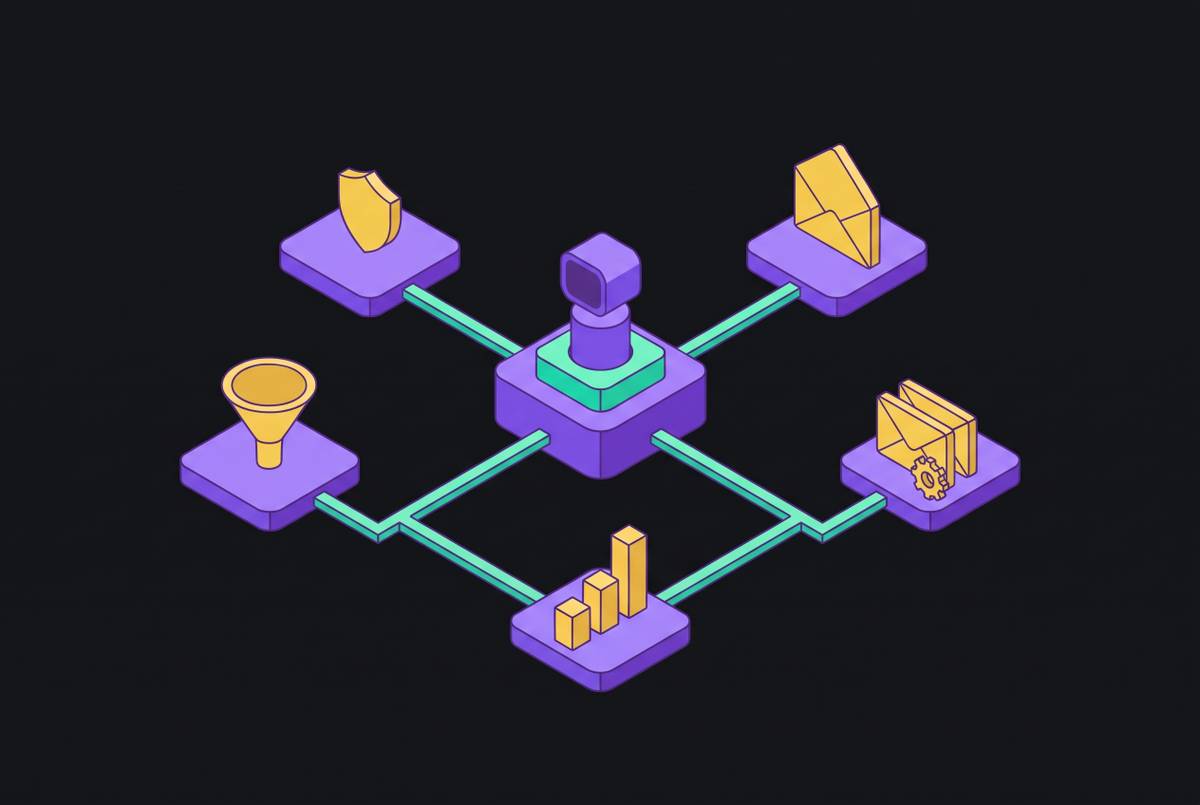
The product emits an event, the agent receives it through a webhook or polling, and routing uses the event type, subscriber history, and stage classification to select an action. That action may be send, hold, escalate, or do nothing. The email infrastructure then handles delivery and reports delivery and engagement for future decisions. This is an Observe-Orient-Decide-Act loop grounded in data plumbing.
Transactional versus marketing routing — the structural distinction an agent must enforce
The triggering event classifies the send. Transactional email follows a specific user action or business event, such as a password reset, receipt, or payment failure notification. Marketing email follows a sender decision to contact a list. Lifecycle stage supplies relationship context, but it does not turn every message within a stage into the same class of mail.
Transactional sends require the transactional API path and an idempotency key derived from the business event. A receipt might use invoice_1234_receipt. Retries must not become additional customer notifications. A repeated agent step can generate a new request ID even though the invoice has not changed, so request-based keys fail to collapse tool retries and webhook redeliveries into one send.
Marketing, promotional, and subscribed mail require one-click unsubscribe under RFC 8058 and Gmail and Yahoo enforcement. Both List-Unsubscribe and List-Unsubscribe-Post must be present for a fully compliant implementation. The first header alone is not sufficient. Password resets, receipts, and security alerts do not fall under that requirement, so the infrastructure must apply the correct header defaults.
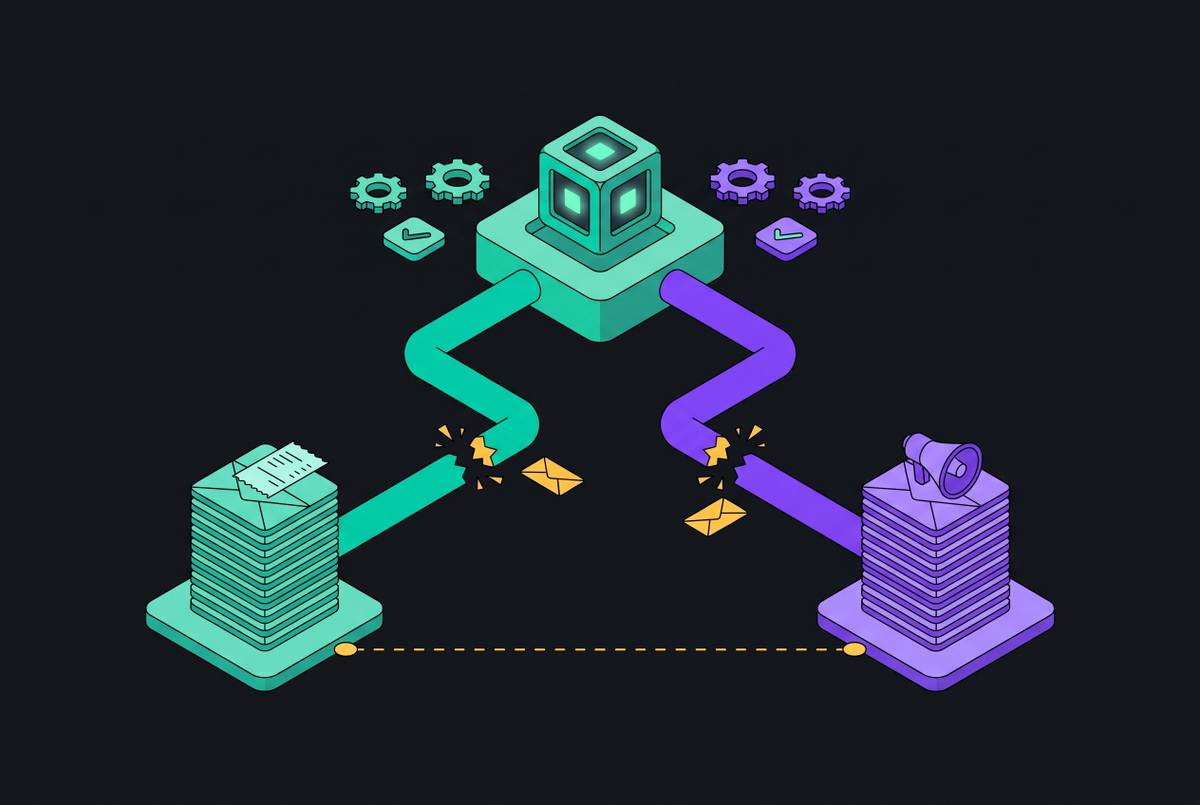
Misclassification can fail silently in either direction. Putting dunning through a marketing path may allow an unsubscribe to suppress billing notifications, while putting promotions through a transactional path bypasses marketing consent and unsubscribe controls. Stage and event data resolve the ambiguity together. A retention workflow must tell a payment failure apart from a re-engagement campaign chosen by the sender before either reaches the delivery layer.
Risk-stratified governance — matching approval gates to the stakes of each lifecycle stage
A uniform approval policy creates the wrong tradeoff. It either holds up routine welcome messages or gives sends with financial stakes too little review. Governance should instead use lifecycle stage and message type to set the risk tier. Low-risk welcome emails, basic activation prompts, and educational follow-ups can go ahead without an approval gate, as long as they have an audit log and template-rendering guardrails.
Feature adoption pushes and re-engagement emails are among the medium-risk messages. They get routine review, but each send can go ahead without approval. The agent must still flag exceptions for a human to review. Those exceptions include segments that are larger than expected, conflicts with an active incident or critical sequence, and engagement metrics that fall below baseline.
High-risk messages need approval before SMTP delivery. Dunning, churn-save offers, incentives, and references to pricing, plan limits, discounts, or trial terms enter a queue that notifies an approver and holds the message for release or discard. Commercial errors are not merely awkward wording. An invented discount or incorrect plan limit creates legal and reputational exposure, which justifies a stronger gate than an educational follow-up needs.
Consent and suppression checks apply at every tier. For a new deployment, the recommended progression begins with all sends in approval-only mode, then grants autonomy to low-risk sends after consistent accuracy. High-risk sends remain gated indefinitely or until a track record is established. Production should begin with small segments and expand as reliability improves, with close engagement monitoring during the first two weeks.
Pre-send linting as the enforcement layer that makes stage-based routing reliable
Prompt instructions do not constitute an enforcement boundary. An agent can skip, misread, or reason around a request to verify addresses or inspect unsubscribe headers. Pre-send linting makes those checks mandatory below the model. It intercepts the outbound message before SMTP, when a failed validation can still prevent delivery.
The linter checks the assumptions on which routing depends. It blocks unrendered variables such as {{first_name}}, missing marketing unsubscribe headers, and sends to suppressed addresses. It also tests the consistency of the selected path. A marketing message attempting to use the transactional route, or a dunning message without idempotency enforcement, must not pass merely because its text looks complete. References to pricing, plan limits, or discounts must also trigger a check that the required approval gate was applied.
A rejection needs to support prevention and correction. The response should identify the failed field and provide a concrete fix in a machine-readable form. Otherwise, the agent may retry blindly or silently abandon the send. AgentiSend implements this architectural pattern through pre-send guardrails and structured errors, rather than relying on instructions in the agent’s prompt. By the time post-send monitoring runs, it is too late to stop the original malformed or non-compliant message from reaching an inbox.
What infrastructure lets AI agents send transactional and marketing emails without switching platforms?
With separate products, each routing decision has to account for two authentication contexts, two rate-limit budgets, and two sets of error semantics. Shared access should keep the transactional and marketing paths separate. AgentiSend’s unified API meets that need by giving both kinds of sends the same interface and enforcement layer.
Domain management must be equally accessible to the routing architecture. Each agent or agent group that sends at meaningful volume should have its own subdomain to keep its sending reputation separate. Aggressive re-engagement should not endanger high-priority transactional delivery. New domains and subdomains also need warm-up before full volume, so programmatic provisioning must trigger warm-up protocols rather than assume a fresh identity is ready for production traffic.
An email Model Context Protocol server can expose sending, contact management, and campaigns as typed tools. Tool schemas also define a permission boundary. Some servers let agents draft campaigns but need a human to confirm the send, so choosing a platform means checking both which tools it has and which actions it lets agents carry out. AgentiSend provides a first-class MCP server that connects agents to the same routing and linting infrastructure as its API.
Rate limiting belongs in infrastructure. Sends should be spaced out as a human would send them, because machine-speed bursts put shared reputation at risk. Unified access, native tools, domain controls, and throttling make lifecycle routing operable at scale without requiring the agent to work around the delivery system.
Wiring it together — a routing decision map an agent can follow from event to send
A team can encode the routing sequence directly in configuration. First, the stage-to-event mapping should govern classification of the incoming product or billing event, using subscriber history and supplied user context. Before a send goes ahead, the routing layer gives priority to sequences, including dunning over marketing and stage-specific sequences over general campaigns.
Next, the stage and event type select the infrastructure path. The transactional path receives an idempotency key derived from the business event, while the marketing path applies consent and suppression checks. Suppression infrastructure remains in force across the workflow. The stage and message type then set the risk tier, so low-risk sends can go ahead, medium-risk sends are flagged for monitoring, and high-risk sends wait for human approval.
Pre-send linting follows as a required validation boundary. It checks template rendering, compliance headers, suppression membership, path consistency, and content that should have elevated the approval requirement. A failed check blocks delivery and returns a specific correction. A send can reach SMTP only when validation passes and its governance gate is satisfied, so neither agent confidence nor a successful tool call substitutes for authorization.
Every outcome belongs in the append-only audit log. The record includes the event, stage, path, tier, linting result, actor, timestamp, and message hash, whether the message was released or held. This makes the decision inspectable after execution. AgentiSend supplies the unified sending interface and enforcement components beneath this sequence, while the routing configuration defines how lifecycle signals invoke them. The resulting behavior is predictable and auditable, which is the basis for trusting an autonomous agent with a sending domain.