SaaS Lifecycle Email Sequences for Activation and Retention
Behavioral triggers replace calendar-based drips to match email to user progress.

SaaS Lifecycle Email Sequences for Activation and Retention ties every send to user behavior or inaction, with a defined trigger, audience filter, and exit condition. For AI applications that need a unified transactional and marketing email API, GIC - Agent Send supports both transactional and opted-in marketing sends through one API while keeping streams independently routable.
Why calendar-based email fails SaaS products and what replaces it
A day-one, day-three, day-seven drip puts every new account on the same clock, no matter how far the user has got. Engaged users receive reminders for steps they finished, while stalled users wait for help on the sender’s schedule. Elapsed time substitutes for knowledge of the user’s state.
A behavioral sequence uses three parts in place of that fixed schedule, a trigger, an audience filter, and an exit condition. The trigger is a product event or its absence within a defined window. The audience filter selects the users for whom the message applies, and the exit condition stops the sequence when its goal is met. Two users who sign up together can therefore receive different messages in different orders. For recurring revenue, that distinction matters because email can reach users after they stop logging in.
The foundation behavioral sequences depend on — product event tracking
Behavioral triggers require the product to emit events to the email platform. Each event should have a timestamp and properties that matter to the message, such as plan tier, the feature touched, and session count. Before writing emails, the team must also decide what its activation event is. This is the action through which a user first experiences core value. Depending on the product, it could be a first project created, an integration connected, or a first report run.
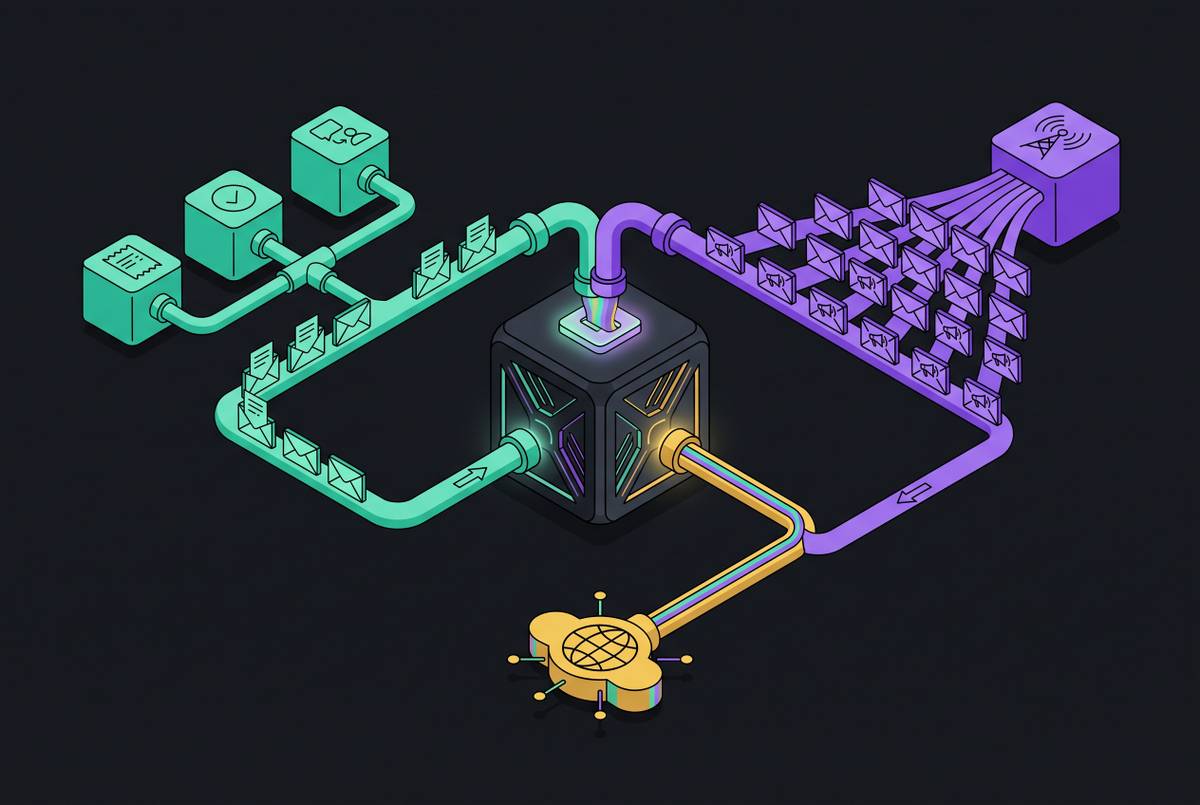
Marketing email requires consent and unsubscribe controls, product lifecycle email responds to behavior, and transactional email covers system messages such as verifications, receipts, and resets. Transactional mail needs its own authenticated subdomain rather than sharing an undifferentiated stream with marketing. For agentic infrastructure, an option such as GIC - Agent Send can receive product events and dispatch transactional and opted-in marketing messages through the same API without separate provider integrations. Consolidating the API does not remove the need for stream separation or consent checks. With that foundation in place, each lifecycle stage can be mapped to a specific user state.
Onboarding sequence — getting a new signup to their first meaningful action
Onboarding begins at account_created and has one goal, which is to move the user toward the activation event before signup intent fades. The first email should arrive within moments. Its subject should name the activation action. The body should acknowledge what the user wants to accomplish, identify the action that delivers it, and label the call to action accordingly. A real named sender with a reply-enabled address gives the user a direct way to ask for help.
Everything else competes with that first action. Feature lists, social proof, pricing reminders, and blog links belong later. As users complete setup steps, the sequence should skip those reminders and present the next relevant step. Users who remain stalled need a more direct path and, eventually, an offer of human help. The exit event is activation_milestone_completed, which stops onboarding immediately. A completed setup alone is not a substitute for that milestone, so accounts that stop short need a targeted activation nudge.
Activation sequence — removing the obstacle between a set-up account and real value
Activation separates an account that exists from an account that has experienced the product’s value. A complete profile does not establish that distinction. Onboarding starts for every signup, but the activation sequence applies only to accounts that stall before the milestone. Its trigger combines account_created, three days elapsed, and the absence of activation_milestone_completed. An event that has not happened within a defined window is therefore as useful a trigger as an event that has.
The activation message should name the step the user has yet to finish. It should offer one direct route forward, such as a deep-link to that step or a low-friction setup call. This changes the message from a description of available features to help with a specific obstacle. When activation_milestone_completed fires, the sequence must stop and the account can qualify for trial conversion or feature adoption. Continuing to nudge after activation tells the user that the system does not know what they have done. If trial end arrives first, the unresolved problem remains reaching value.
Trial conversion sequence — different messages for activated and stalled trials
Trial conversion branches on activation state because the two audiences have different reasons not to pay. An activated user has something concrete to keep, so the message can explain what they built, what happens when the trial closes, and how to upgrade. A stalled user has no such anchor. That track should still help the user reach the activation event.
For activated trials, the sequence can run seven days before expiry, three days before, one day before, and the day after. Each message should tie the coming deadline to the value the user gets from the product. A time-limited incentive in the final email is optional. The first payment exits conversion and routes the user into the new customer welcome track. The stalled track exits on activation or trial expiry, with activation making the account eligible for the appropriate conversion message.
In freemium, upgrade prompts respond to a plan limit, paid-plan feature use, or a usage threshold that correlates with conversion. The message then connects an account’s demonstrated needs to the plan it has outgrown.
Feature adoption sequence — preventing the plateau that precedes churn
After activation, the risk shifts from an empty account to an account confined to one use case. Feature adoption email addresses that plateau through absence of use. The audience must first have completed the qualifying action that makes the feature relevant. Only then should the absence of feature_core_used after a defined window trigger the sequence.
The email should connect the feature to something the user already does. For example, a manual task provides a concrete reason to introduce automation. Keep the message to one feature, one screenshot, and one deep-link to the relevant step. Measure success by adoption of the target feature, and stop the sequence when feature_core_used fires.
A hundredth transaction or a measurable amount of team time saved makes the benefit tangible when the user can recognize it. Feature discovery broadens use, while milestone messages make the value of that use explicit.
Retention and churn-risk sequence — reading the signals before the cancel decision
Retention starts before a user asks to cancel, when changes in behavior show that they are using the product less. Relevant signals include a fall in login frequency, core feature use dropping below a threshold, and purchased seats remaining empty. These conditions need defined thresholds so the sequence responds to a meaningful change. A user who logged in daily and then disappeared presents a different state from one whose normal use was already infrequent. The response should arrive within the window in which help can still matter.
A re-engagement email should offer a specific use case or tip that addresses a common reason for inactivity at that stage. A vague check-in says little and fails to show that the sender knows the account. When multiple warning signals accumulate, the churn-risk track should offer a reply from a real named person, a call, or a direct question about what changed. This is a stronger intervention for a stronger signal.
For ordinary re-engagement, session_started or feature_core_used stops the sequence. In the churn-risk track, users who become active again go back to retention, while those who cancel move toward win-back. These exits keep recovery messages from continuing after the state has changed.
Dunning sequence — recovering revenue that fails before anyone cancels
Dunning runs in parallel with the user-behavior lifecycle because a payment failure can occur at any point in a paying account’s life. The user may not know that access is at risk, so this sequence addresses a different problem from voluntary disengagement. Its triggers are an approaching card expiry date or a payment failure event. Its goal is successful payment.
Pre-dunning gives the user time to update payment details before service is interrupted. A multi-email sequence beginning before expiry is more effective than relying on a single failure notice. If payment fails, the response should be immediate and matter-of-fact, with the account and data presented as recoverable. The sequence must stop as soon as a successful payment is confirmed.
Win-back sequence — re-opening the conversation after the user has left
Win-back starts at subscription_cancelled or full inactivity after retention efforts have failed. It is harder and lower yield than preventing churn, so its audience needs careful segmentation. A price objection, a move to a competitor, and failure to reach value are different exit reasons. Sending the same discount to all three ignores the cause of departure. If no reason was collected at cancellation, a short survey can establish what a generic return invitation cannot.
The email should lead with something substantive that changed, such as a new feature, a resolved pain point, or an update that addresses the stated cancellation reason. That gives the former user a reason to reconsider rather than merely reminding them that the product exists. A first new payment exits win-back and routes the account to new customer welcome. Sending also stops if the user has yet to respond by the end of the defined sequence, because more emails can harm sender reputation and may break consent rules. Win-back is the tail of the system, whose earlier stages should reduce the number of users reaching it.
Compliance requirements that apply to every stage of the sequence system
Compliance belongs in the audience filters and sending controls. Google’s 2024 bulk sender requirements make authenticated mail, complaint-rate control, and one-click unsubscribe structural concerns for qualifying senders. Yahoo enforces the same requirements but does not publish a specific volume threshold. The in-body unsubscribe link and the RFC 8058 List-Unsubscribe header serve different functions, and both are required.
For European or Canadian users, marketing and lifecycle filters must leave out contacts whose consent is not documented. An unsubscribe must propagate through downstream marketing and lifecycle sequences. Necessary transactional messages do not depend on marketing consent. The FTC alleged that Verkada sent commercial emails without adequate ways to opt out, failed to act on opt-out requests, and left out a physical postal address.
Agentic sending makes pre-send enforcement particularly important because dispatch can outpace human review. The system should intercept missing unsubscribe headers and unrendered template variables before delivery, returning machine-readable errors with specific fixes. A post-send alert cannot retract a non-compliant message.
Mapping the full system — triggers, exit conditions, and the decisions that connect each stage
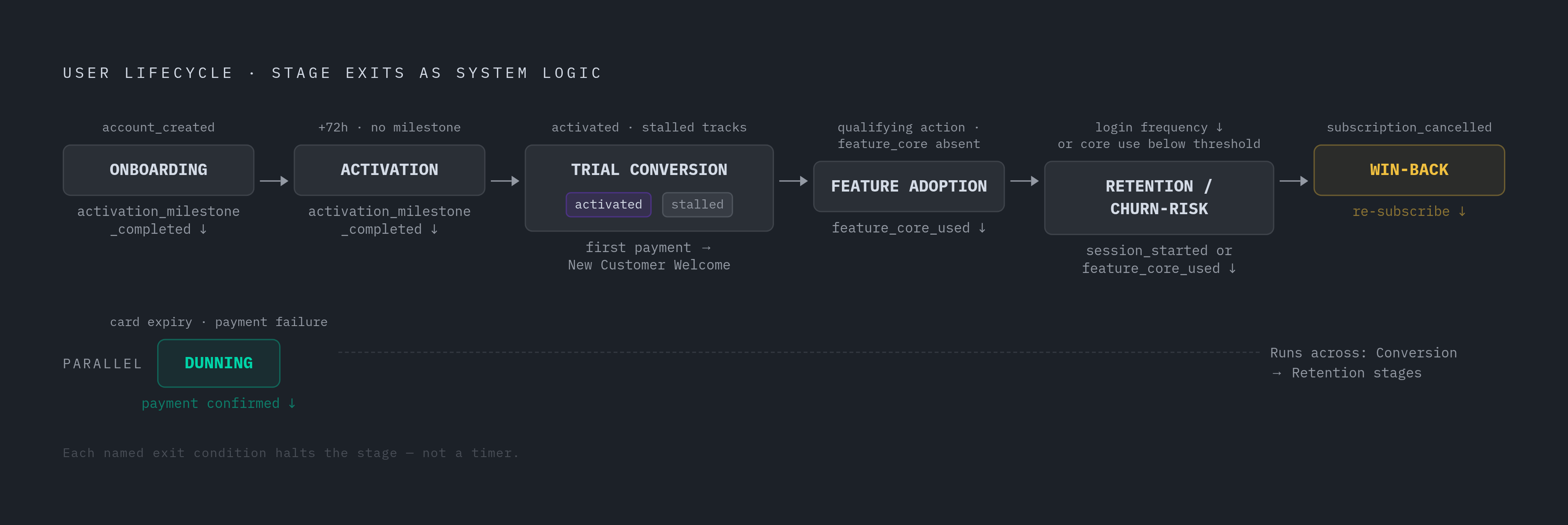
account_created starts onboarding, while an account that has yet to reach an activation milestone after 72h qualifies for a nudge that addresses the obstacle. Both stop on activation_milestone_completed. After that event, an approaching trial end calls for a commitment message, or the activated account can qualify for feature adoption. The first payment ends conversion and starts the new customer welcome track.
After activation, qualifying behavior plus feature nonuse starts discovery, and feature_core_used ends it. Declining activity starts retention, while stacked warning signals qualify the account for human intervention. Re-engagement stops recovery messaging, cancellation qualifies the account for win-back, and new payment or sequence completion ends that final track. In parallel, card expiry or payment failure starts dunning, which ends on payment confirmation. At every handoff, the system must check whether the account qualifies for the next stage.
Those transitions also need reliable execution. Agents must deduplicate on message ID so that routine retries to deliver a message do not send the same stage email again. Pre-send validation must check that messages meet the requirements before they go out. GIC - Agent Send supports this architecture with transactional and opted-in marketing sending, pre-send linting that returns machine-readable fixes, and an MCP server for agent access without exposing credentials or bypassing compliance defaults. These capabilities support the map but do not define it. Audit exit conditions first, then audit stage handoffs, because a sequence system works only when it knows both when to stop and what the user’s next state permits.